Surface-mounted LED downlights solve the lack of a false ceiling. Compare ceiling lights, slim panels, finishes and...
.svg)

Slim recessed LED downlights: guide to models, wattages and prices
An interior designer who was refurbishing a flat in central Madrid needed recessed luminaires that would barely reduce the depth of the false ceiling. The building was old, the available cavity was under 4 cm and any conventional slim recessed LED downlight was ruled out. He also wanted dimmable warm light and a clean finish that wouldn't break the minimalist aesthetic of the project.
He looked at the technical datasheets in our catalogue, chose the 20W square slim model with selectable CCT and ordered 12 units, which he received within 48 hours. This guide was born from that experience and from the dozens of similar enquiries we receive every month.
What is a slim LED downlight and how does it differ from a conventional one
When we talk about a slim downlight vs conventional downlight, the most obvious difference lies in the profile. A traditional downlight needs between 10 and 15 cm of space above the false ceiling, while an ultra-slim model rarely exceeds 3 cm. The internal driver design, heatsink layout and chip type all influence performance.
Thickness and ceiling cut-out required
The ceiling cut-out in millimetres varies depending on the diameter or frame size. For small 8W circular models we are talking about a cut-out of around 105 mm, while 26W versions can require up to 280 mm. The interesting point is that the recessing depth stays below 30 mm in most slim references.
Advantages of the ultra-slim design
Why opt for an ultra-slim recessed luminaire? The reasons are as follows:
- Installation in tight spaces: ceilings with a shallow cavity, plasterboard coffers or structures where every centimetre counts.
- Minimum weight: the lightweight structure reduces stress on the false ceiling.
- Refined aesthetic: the frameless downlight or one with a slim perimeter frame sits almost flush with the surface.
- Efficient heat dissipation: models with Osram Duris chips maintain low temperatures thanks to the aluminium plate that acts as a heatsink.
- Anti-flicker effect: quality drivers incorporate anti-flicker technology, something you notice in your eyes after hours under that light.
Types of slim downlight: circular vs square
The choice between shapes is not just aesthetic. It influences light distribution, the cut-out and the visual perception of the space. Both options share the same internal LED technology.
Circular models: wattages from 8W to 26W
The circular slim LED downlight price is more accessible, and it is the most popular option in residential refurbishments. In our catalogue you will find wattages of 8W, 12W, 18W, 20W and 26W, with a beam angle of 120°. The 18W and 20W slim LED downlight models are best suited for medium-sized rooms.
Square models: finishes and dimensions
The square slim LED downlight adds a more contemporary touch. It is common to see them in interior design installations and in commercial spaces where straight lines are sought. We stock versions with white, chrome and nickel finishes. Square cut-out sizes range from 110×110 mm to 280×280 mm.
Key technical features to consider
Before adding units to the basket, it is worth reviewing three parameters that make the difference between a wise purchase and a disappointment.
Selectable CCT: choose the colour temperature
A selectable CCT slim downlight allows you to switch between warm white 3000K, neutral 4000K and cool 6000K using a switch on the rear. This is very useful when you are unsure which selectable colour temperature would best suit the space, or even when the same model needs to serve different zones within the same project. If you prefer a fixed tone, the neutral white slim downlight at 4000K is the most balanced choice for offices and retail.
High CRI for quality light
The CRI colour rendering index measures how faithfully a light source reproduces real colours. Our models with Osram chips achieve a CRI above 80 and some approach 90, meaning fabrics, food and decorative finishes are perceived naturally. For a fashion shop or a jeweller's, this figure is extremely important.
Dimming and compatibility with dimmers
Do you need a dimmable slim downlight? Make sure the model features a driver compatible with phase-cut dimming.
Not all slim models are dimmable, so check the technical datasheet. Dimming allows you to create atmospheres, reduce consumption and extend the LED's lifespan. And yes, the best quality slim LED downlight always includes this option.
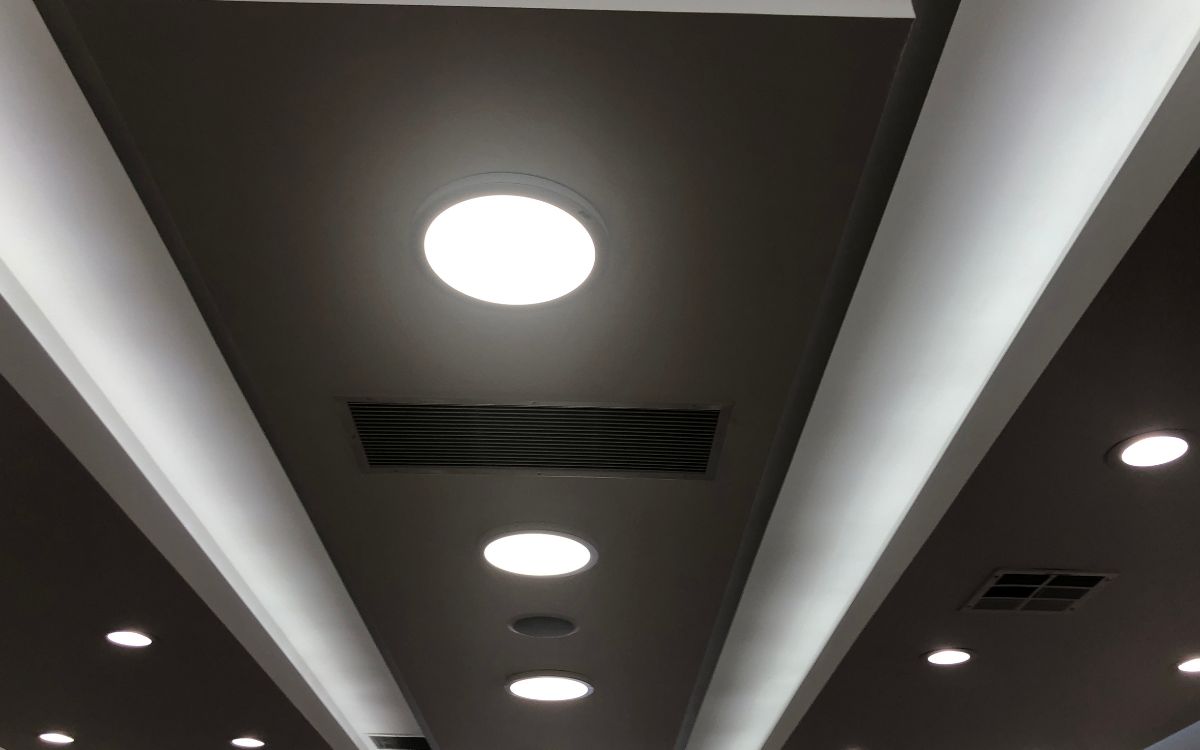
Step-by-step installation in a false ceiling
Installing an ultra-slim recessed downlight is within the reach of anyone with basic DIY knowledge. It is a no-building-work recessed downlight — you don't need to renovate the ceiling, just make a clean hole.
Tools you will need
- Hole saw of the correct diameter or a utility knife for plasterboard.
- Drill or screwdriver.
- Pencil and tape measure to mark centres.
- Quick-connect terminal or connector strip.
- Stud and cable detector (recommended).
How to make the cut-out and fix the downlight
Mark the centre of the light point, draw a circle or square according to the cut-out size and cut with the hole saw. Plasterboard false ceiling installation is the most common — the downlight's spring clips grip the panel without screws. Connect live, neutral and earth to the driver's terminal, push the luminaire into place and you're done. In under five minutes per point you have a slim LED false ceiling downlight up and running.
Applications by space
Not all environments call for the same wattage or the same tone.
Slim downlight for living rooms and bedrooms
In rest areas, the slim LED recessed ceiling panel of 12W or 18W in warm 3000K tone creates an enveloping atmosphere. If the living room is large, combine several 18W points with a selectable CCT model to adjust according to the time of day.
Slim downlight for retail premises and shops
In retail, the aim is to highlight the product. A slim LED downlight for shops of 20W or 26W with high CRI and neutral tone ensures merchandise colours look true to life. The 20W Osram slim downlight is one of the most requested references by specifiers, thanks to its balance between wattage, energy efficiency and price.
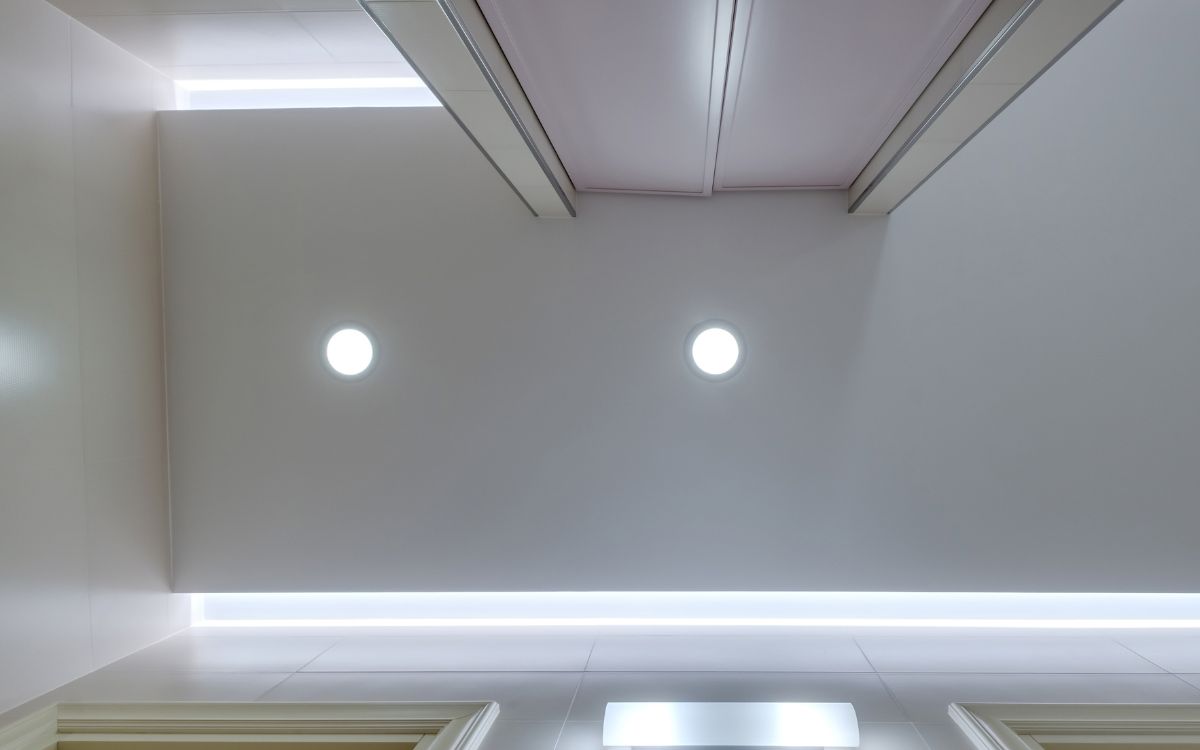
Catalogue model comparison and prices
Here is a summary table with the best-selling references. Prices exclude VAT:
| Model | Selectable CCT | Price |
|---|---|---|
| Circular Slim LED Panel 6W White – CCT | Yes | €4.34 |
| Circular Slim LED Panel 10W White – CCT | Yes | €6.40 |
| Circular Slim LED Panel 10W Stainless Steel – CCT | Yes | €5.23 |
| Circular Slim LED Panel 15W White – CCT | Yes | €8.85 |
| Circular Slim LED Panel 18W White | No | €5.40 |
| Circular Slim LED Panel 20W White | No | €6.42 |
| Circular Slim LED Panel 20W White Adjustable | No | €7.87 |
| Circular Slim LED Panel 24W Stainless Steel – CCT | Yes | €9.62 |
| Circular Slim LED Panel 26W White – CCT | Yes | €14.75 |
| Square Slim LED Panel 8W White | No | €3.14 |
| Square Slim LED Panel 20W White | No | €7.06 |
| Square Slim LED Panel 24W – CCT White | Yes | €10.09 |
If you are looking to buy a cheap slim LED downlight without sacrificing features, the 8W and 12W slim models offer excellent value for money.
Frequently asked questions about slim LED downlights
What cut-out is needed to install a slim downlight?
It depends on the model and wattage. The smallest 8W circular ones need around 105 mm, while 26W models go up to 280 mm. Always check the technical datasheet before cutting.
Can slim downlights be installed in plasterboard ceilings?
Yes. The fixing clips grip 13 or 15 mm plasterboard panels perfectly. No additional reinforcement is needed.
What is the difference between a circular and a square slim downlight?
Fundamentally the aesthetic and the type of cut-out. In terms of light output, both perform equally with the same wattage and chip. The square fits better with straight-line décor, while the circular is more versatile.
Can I dim a slim downlight?
Only if the model incorporates a dimmable driver. Look for the dimmable label on the datasheet. A dimmable slim downlight also requires a phase-cut LED-compatible dimmer.
What wattage do I need to light a room properly?
As a general rule, calculate around 15–20W LED per 10 m² in residential rooms. For retail, increase to 25–30W LED per 10 m² if you want bright, uniform lighting.
What does selectable CCT mean in a downlight?
CCT stands for Correlated Colour Temperature. A model with selectable CCT lets you choose between several colour temperatures — typically warm, neutral or cool — via an integrated switch, without having to change the luminaire.
Are slim downlights compatible with motion detectors?
Yes, provided the detector is installed on the downlight's supply circuit. There is no electrical restriction. It is a very practical solution for corridors, garages and communal areas where the light does not need to be on continuously.
Posted in:
Sample Category
Related posts
60x60 LED panels: everything you need to know before buying
Discover how to choose the ideal 60x60 LED panel for your project. We compare drivers, wattages, installation types...
Read more
A practical guide to choosing the perfect LED lighting for your office
Find out how to choose the perfect LED lighting for your office: it complies with the EN 12464 standard, boosts your...
Read more
LED colour temperature: how to choose between 2700K, 4000K and 6500K for your space
Warm, neutral or cool light: each LED colour temperature has its ideal space. We explain the differences between...
Read more
LED track spotlights for shops: single-phase vs three-phase, models and installation keys
Single phase or three-phase? Choosing the right LED track system makes the difference between a well-lit shop and one...
Read more
LED Lighting for Shops: Light Strategies That Drive Sales
Discover how LED lighting boosts shop sales: lux levels by zone, CRI, colour temperature and common mistakes to avoid...
Read more
Search in blog
Blog categories
Latest posts
Surface-mounted LED downlights: ceiling lights and slim panels for ceilings without building work
Read more
Linear LED lighting for hospitality: ideas and solutions for bars, restaurants and hotels
Read more
Linear LED lighting sets the mood in bars, restaurants and hotels. Discover the types of luminaires, key areas and...
Aluminium profiles for LED strips: types, diffusers and how to choose the right mounting
Read more
Discover the aluminium profiles available for LED strips, which diffuser to choose and what accessories you need for...
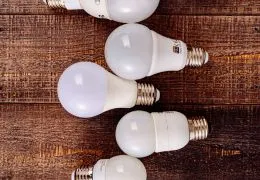
LED vs halogen: complete comparison of performance, savings and light quality
Read more
Is it worth switching your bulbs? This LED vs halogen comparison covers energy consumption, lifespan, heat and light...
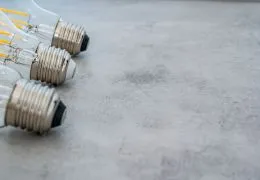
E27 LED Bulbs: direct replacement guide by shape, wattage and colour temperature
Read more
Practical guide to replacing your old bulbs with E27 LED bulbs without complications. Learn how to choose shape,...
Popular posts
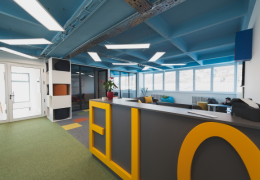
60x60 LED panels: everything you need to know before buying
Discover how to choose the ideal 60x60 LED panel for your project. We compare drivers, wattages, installation types...
Read more
A practical guide to choosing the perfect LED lighting for your office
Find out how to choose the perfect LED lighting for your office: it complies with the EN 12464 standard, boosts your...
Read more
LED colour temperature: how to choose between 2700K, 4000K and 6500K for your space
Warm, neutral or cool light: each LED colour temperature has its ideal space. We explain the differences between...
Read more

LED public lighting: current regulations, technical requirements and key points for compliance
Guide to Spain's LED public lighting regulations: technical requirements, road classes, parameters and mandatory...
Read more
Slim recessed LED downlights: guide to models, wattages and prices
Discover the differences between circular and square models, available wattages from 6W to 26W, key features such as...
Read more
Leave a comment