LED panels are the lighting solution that has earned a permanent place in offices, educational centres, clinics and large retail spaces.
They combine an ultra-thin profile with uniform lighting for workspaces that no recessed fluorescent can match. If you need to buy an LED panel for your office, whether for a one-off refurbishment or a full project, this is the technical information you need.
What is an LED panel and where is it installed
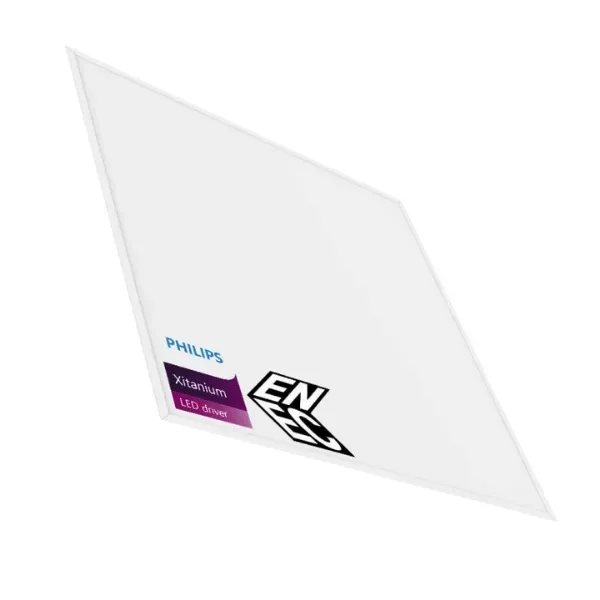
An LED panel is a type of luminaire that distributes light evenly thanks to an internal light guide. Its thickness is around 8-12mm in slim luminous frame models, which allows it to be integrated into virtually any ceiling.
The suspended ceiling LED panel is the most common option in professional environments where visual comfort is required:
- Offices
- Classrooms
- Meeting rooms
- Reception areas
Mounting versatility is another strong point. There are two main installation methods and the choice depends on the type of ceiling available.
Recessed installation in a suspended ceiling
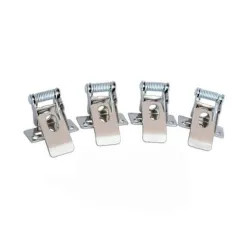
The most common format. The recessed LED panel sits within the suspended ceiling lighting structure, replacing the standard 60x60cm tile. The recessed installation leaves the ceiling surface completely flush, with no protrusions or visible profiles. Simply remove the tile, connect the wiring to the driver and slot the panel in.
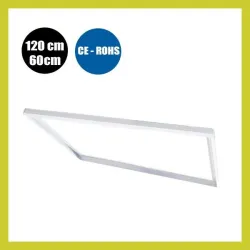
Surface installation with an adapter kit
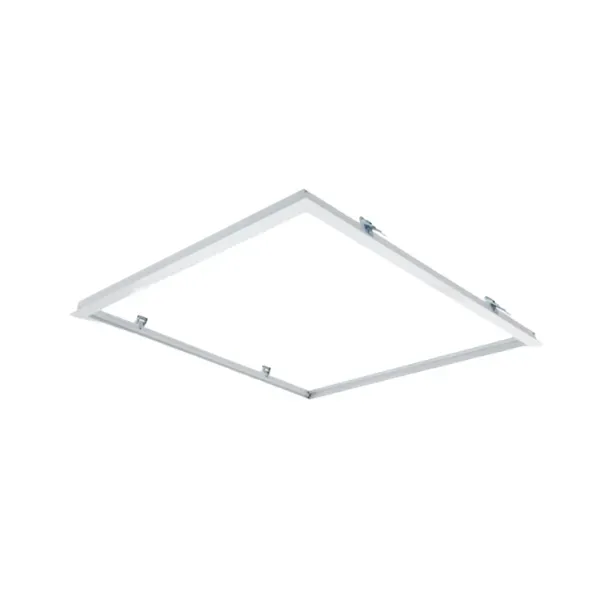
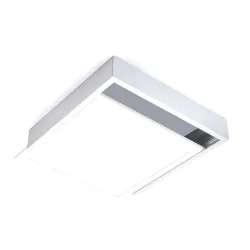
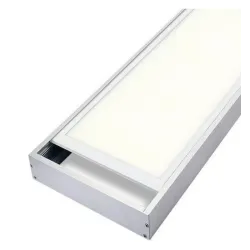
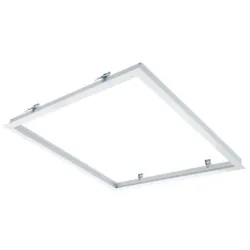
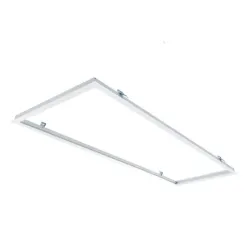
When there is no suspended ceiling or when it is a continuous plaster ceiling, a perimeter frame screwed to the ceiling is used. This way the surface-mounted LED panel is securely fixed without any building work. The adapter kit is usually sold separately, so it is worth checking compatibility with the chosen format.
Available LED panel formats
Not all spaces call for the same size. The choice of format affects both the lumens per watt efficiency and the final appearance of the project. Let's look at the three best sellers.
60x60 LED panel: the most popular
The 60x60cm LED panel fits directly into modular suspended ceiling grids, which are the standard in offices and schools. With power ratings ranging from 30W to 48W, it covers most requirements. A 40W model with a good driver easily reaches 3600 lm, which translates into a real 90 lm/W.
120x60 and 120x30 LED panels for linear spaces
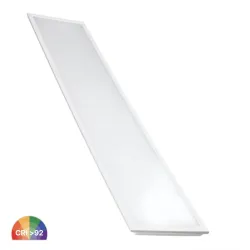
The 120x60 LED panel doubles the luminous surface and is ideal for wide corridors, open-plan rooms or warehouses with large-format technical ceilings. Its smaller sibling, the 120x30 LED panel, offers a more streamlined design and integrates well into ceilings with narrow profiles. Both models deliver a highly competitive low-consumption office LED panel when compared with fluorescent luminaires of similar dimensions.
Technical features to consider
Choosing a panel on price alone is a mistake you pay for in flickering, lumen depreciation and complaints. These are the three technical factors that make the real difference.
UGR19 for glare-free workspaces
The UGR19 office rating ensures that glare remains below the visual comfort threshold required by standard EN 12464-1. If the panel is destined for workstations with computer screens, a UGR19 LED panel is mandatory to comply with occupational health and safety regulations.
DALI and 1-10V dimming for advanced control
A DALI dimmable LED panel allows the light intensity to be adjusted from a centralised management system, which is common in smart buildings. The simpler alternative is 1-10V dimming, which works with a standard potentiometer. A 1-10V dimmable LED panel is compatible with most existing installations without adding a data bus, which reduces costs. Using a DALI dimmable driver provides full flexibility to programme scenes, schedules and presence sensors.
Philips and Lifud drivers as a mark of quality
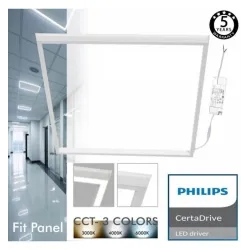
The driver is the heart of the panel. A Philips driver LED panel incorporates independently certified power supplies with a failure rate of less than 0.5% in the first 20,000 hours. The Lifud driver LED panel offers a very competitive quality-to-price ratio and also holds CE and RoHS certification. Both manufacturers provide drivers with ENEC-certified chips, which backs up the electrical safety of the whole unit.
Advantages of buying in bulk
When a project involves multiple light points — an entire office, a school, a clinic — buying individual units makes no sense. Packs are designed for those looking for volume at a fixed price.
Volume savings for installers
A 60x60 LED panel pack of between 10 and 40 units can mean a discount of up to 15% compared with the unit price. For installers and maintenance companies, that margin makes the difference in the final quote to the client.
The advantages of buying in bulk include:
- Reduced unit price with a single invoice.
- Same production batch: consistent 4000K colour temperature across all panels.
- Consolidated shipping with lower logistics costs.
- Immediate stock availability for urgent projects.
Extended warranty on selected models
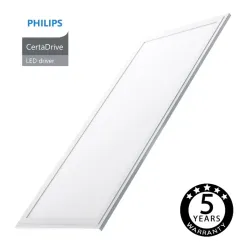
Several models with Philips or Lifud drivers offer a 5-year warranty. This coverage includes the driver and the LED module, which are the two components with the highest risk of failure. Before placing a large order, it is worth reviewing the specific conditions for each product reference.
LED panel catalogue
Our catalogue includes the main combinations of format, power and driver type. Here is a summary of the ranges available:
- 60x60 LED panel: 30W-40W-48W with Philips, Lifud or standard drivers.
- 120x60 LED panel: 60W-72W ideal for large areas.
- 120x30 LED panel: 36W-40W narrow profile for linear designs.
- Slim frame LED panel: 8mm frame with a premium look for retail and hospitality.
DALI and 1-10V dimmable versions available in all formats.
The industrial LED lifespan of these panels exceeds 50,000 hours under normal operating conditions, which is equivalent to more than 11 years running 12 hours a day. Few products offer such a clear return on investment.
Frequently asked questions about LED panels
What is the difference between an LED panel with a Philips driver and a standard one?
The Philips driver has a documented failure rate of less than 0.5%, independent ENEC certification and greater current stability. A generic driver may work, but its lifespan and reliability are notably lower.
Can I install a 60x60 LED panel on a surface?
Yes. You need an adapter frame kit that is screwed to the ceiling. The panel is fixed inside the frame and sits on the surface without the need for a suspended ceiling.
What does UGR19 mean on an LED panel?
UGR is the Unified Glare Rating. A value equal to or below UGR 19 indicates that the luminaire complies with European regulations for workstations with screens. It is a technical requirement, not a commercial extra.
Are DALI dimmable LED panels compatible with any home automation system?
DALI is an international standard protocol (IEC 62386). Most professional home automation systems — KNX, Loxone, Control4 — integrate DALI gateways. However, it is worth verifying controller compatibility before installation.
How many LED panels do I need to light a 50m² office?
Standard EN 12464-1 requires a minimum of 500 lux on the working plane for offices. With 40W panels producing 3600 lm, approximately 8-10 units are needed to cover 50m² with uniform distribution, depending on ceiling height and wall colour.
.svg)