24V DC LED strips allow long runs to be installed without voltage drop or colour variation. Discover the available...
.svg)

LED public lighting: current regulations, technical requirements and key points for compliance
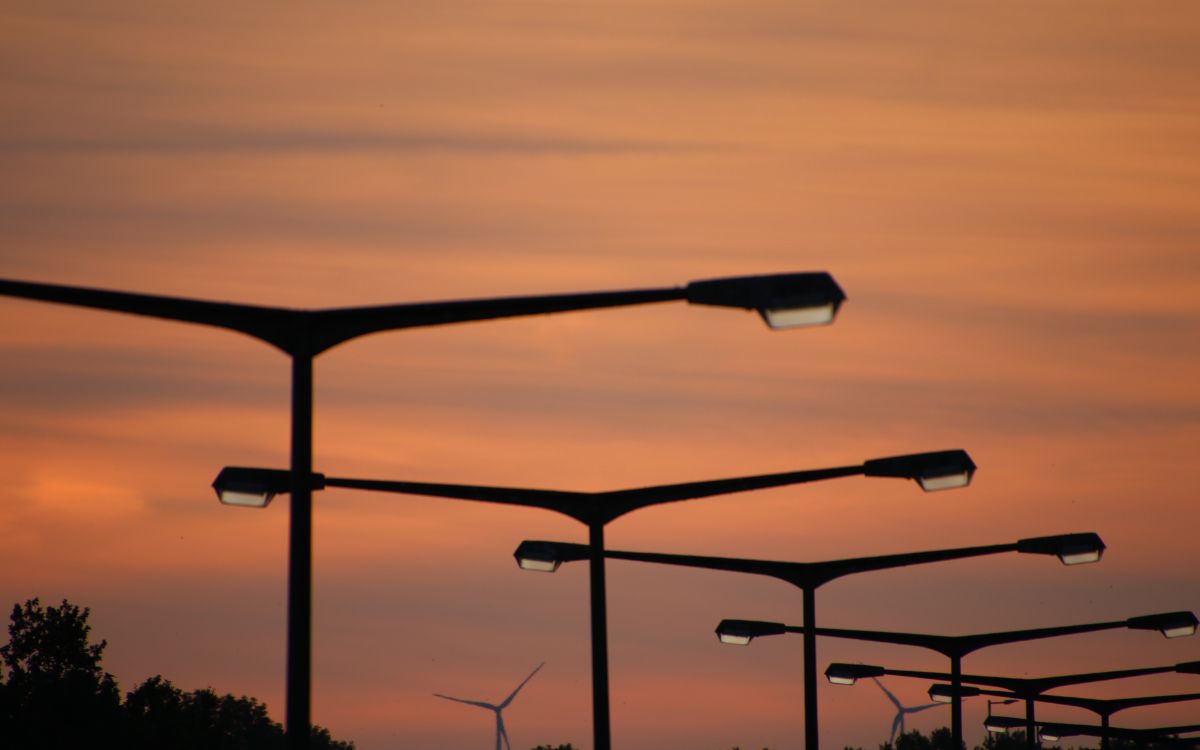
Public LED lighting regulations in Spain are not a field open to interpretation. There are regulations, technical standards and specific parameters that any external lighting installation must comply with. Whether it is a new construction or renovation of an existing network. This article sets out the requirements so that technicians, installers and municipal managers can prepare their projects with criteria and without searching through the Official State Gazette for hours.
Regulatory Framework for External Lighting in Spain
The external lighting sector in Spain operates under an established regulatory framework, although with several layers that are worth distinguishing.
Energy Efficiency Regulation in External Lighting RD 1890/2008
Royal Decree 1890/2008 is the principal reference for any public lighting installation in Spain. It approves the Regulation on Energy Efficiency in External Lighting (REEAE) and its supplementary technical instructions (ITC-EA). It establishes the limits of installed power, admissible energy efficiency indices and the requirements for installation qualification.
This regulation requires that each new installation or substantial renovation must demonstrate its energy rating for the lighting installation by means of an energy efficiency index (IEA). The minimum value required varies depending on the type of road and the projected lighting level. Along with RD 1890/2008, sectoral regulations require compliance with the electrical installations regulation. Regarding the supply, wiring and electrical protections of the lighting points.
The decree on public lighting in Spain also includes requirements for programmable hourly flux reduction. Installations must be able to reduce luminous flux during lower traffic hours, which requires incorporating flux regulators or remote management systems. A twilight sensor with automatic regulation can meet this requirement simply in small installations, although more complex projects require centralised systems.
UNE EN 13201 Standard road lighting classes
The UNE EN 13201 standard on road lighting classes is the European technical reference for classifying roads according to their lighting needs. It defines classes M (motorways with motor traffic), C (conflict zones and junctions) and P (pedestrian roads). The road lighting class M C P assigned to each section determines the minimum values of luminance, illuminance and uniformity that the installation must achieve.
The selection of the correct class depends on the analysis of design speed, traffic volume, presence of pedestrians and type of environment. This classification is the first step in any external lighting project.
Technical Parameters Required for a Public Lighting Installation
Once the road class has been defined, the project must demonstrate that the calculated values comply with regulatory thresholds.
Illuminance and Luminance Levels by Road Type
The regulatory luminance level on the road surface varies according to the assigned class M. The following table shows the reference values according to UNE EN 13201 for the most common classes:
| Class | Mean Luminance (cd/m²) | Overall Uniformity U₀ | Longitudinal Uniformity Ul | Glare TI (%) |
| M1 | ≥ 2.0 | ≥ 0.4 | ≥ 0.7 | ≤ 10 |
| M2 | ≥ 1.5 | ≥ 0.4 | ≥ 0.7 | ≤ 10 |
| M3 | ≥ 1.0 | ≥ 0.4 | ≥ 0.6 | ≤ 15 |
| M4 | ≥ 0.75 | ≥ 0.4 | ≥ 0.6 | ≤ 15 |
| M5 | ≥ 0.5 | ≥ 0.35 | ≥ 0.4 | ≤ 15 |
| M6 | ≥ 0.3 | ≥ 0.35 | ≥ 0.4 | ≤ 20 |
For pedestrian roads (class P) the values are expressed in mean horizontal illuminance, with a minimum of 5 lux for class P3 (low-activity residential areas) and higher values for commercial or high-traffic environments.
The calculation is based on installed power W/m² of public road as an energy control parameter. The spacing between lighting points directly affects the uniformity achieved. Excessive spacing between luminaires produces illuminance drops that fail to meet uniformity thresholds, even if the installed power is sufficient.
Uniformity Factor and Glare
The uniformity factor in road lighting is as demanding as the mean luminance value. An installation that achieves the correct mean luminance but with uneven distribution does not comply with the standard. The glare index (TI) controls the disturbing effect on drivers and is limited to values between 10% and 20% depending on the class.
Flux Emitted to the Upper Hemisphere FHS
The upper hemisphere flux FHS measures what percentage of the total luminous flux emitted by the luminaire goes upwards towards the sky. Spanish regulations set maximum limits according to the zone of protection against light pollution. In E1 zones the FHS must be 0%; in E2 zones, up to 0.5%; in E3 and E4 zones, slightly higher values but always reduced.
LED luminaires with full cut-off optics comply with these requirements without difficulty. This is one of the strongest technical arguments in favour of LED technology over high-pressure sodium in network renovations.
Requirements for Public Lighting Luminaires
Installation parameters are met or not depending on the characteristics of the luminaires themselves. There are three attributes that any tender technical specification must require.
Required IP and IK Protection Rating
The IP and IK requirements for LED street lights most common in public roads are IP66 and IK08 or IK10. IP66 is the minimum for most urban installations. Areas at risk of vandalism or impact may require IK10.
Recommended Colour Temperature for Public Roads
The colour temperature regulation for public lighting does not set a single value. However, RD 1890/2008 and sector recommendations place the optimum range between 3,000 K and 4,000 K.
Values below 3,000 K are appropriate in residential environments or areas with greater requirements for protection against light pollution. Above 5,000 K, blue light emission increases the apparent FHS. It can negatively affect fauna and rest in residential areas.
The minimum colour rendering index Ra recommended for public roads is Ra ≥ 60. Although in commercial pedestrian areas or security environments, Ra ≥ 70 is recommended to facilitate the recognition of people and objects.
Minimum Efficiency in lm/W According to Regulations
The IEA for efficient external lighting requires that the luminaire-equipment assembly exceeds a minimum efficiency. Current quality luminaires for public roads must exceed 100 lm/W in the finished product. RD 1890/2008 sets minimum energy efficiency indices by section, and recent tender specifications usually require values between 110 and 140 lm/W. To ensure the energy efficiency of municipal lighting throughout the product's useful life.
The maintenance factor for lumen depreciation is another mandatory parameter in the project. The luminaire must maintain at least 80% of its initial flux at 25,000 operating hours. The depreciation factor of the assembly must include both LED depreciation and dirt accumulated on the optics.
The CE and RoHS certification for public lighting is an essential requirement for any luminaire installed in the public network. Without CE marking, the luminaire cannot be included in an approved project or in a public tender.
Light Pollution E1 E2 E3 E4 Zones
The light pollution regulation for LED lighting is regulated in Spain primarily through RD 1890/2008 and complementary regional legislation. Installations are classified according to the surrounding zone: E1, E2, E3 and E4.
Each zone has limits on FHS, maximum facade luminance and values of light obstruction. A project that does not correctly identify the applicable E zone runs the risk of failing the technical inspection of the external lighting after completion.

Audit and Energy Certification of Lighting Installations
The audit of public LED lighting is not a minor bureaucratic procedure. It is the mechanism by which the installation owner demonstrates compliance with the required energy efficiency indices. Where applicable, it identifies necessary improvements.
The process includes an inventory of lighting points, measurement of illuminance in the field, calculation of the resulting energy rating for the lighting installation and comparison with the RD 1890/2008 thresholds. For installations with more than 5,000 lighting points, periodic audit is mandatory. The result determines the public grants available for network renovation, so it is advisable to carry it out rigorously even when not strictly required.
The technical requirements for LED street lights on public roads must be documented in the audit file:
- Nominal power
- Initial flux
- Maintenance factor
- Photometric data (LDT or IES file)
- Product certificates.
How to Know if Your Current Installation Complies with Regulations
The public LED lighting regulations in Spain do not require all installations to be renovated immediately. However, they do establish that any substantial renovation must leave the network in compliance with the REEAE. The first step is to cross-check the network inventory with the energy efficiency indices calculated according to the technical instructions of RD 1890/2008.
If the network has high-pressure sodium or mercury vapour luminaires, non-compliance with efficiency thresholds is almost certain. Renovation to LED technology allows for improvements in energy efficiency, uniformity factor, FHS and service life, reducing maintenance costs.
At ibericadeiluminacion.es we have a complete range of LED street lights for public roads that comply with the technical and certification requirements set out in Spanish regulations. If you need technical advice for your project or tender, contact our team.
Frequently Asked Questions about Public LED Lighting
What Regulations Govern Public Lighting in Spain?
Royal Decree 1890/2008, which approves the Regulation on Energy Efficiency in External Lighting, is the principal regulation. It is complemented by the UNE EN 13201 standard for road classification and by regional regulations on light pollution.
How Many Lux Should a Residential Street Have?
It depends on the assigned lighting class. A low-speed residential road typically corresponds to classes M5 or M6 or to class P3 in pedestrian areas. They must have a minimum of 5 horizontal lux.
What Do M4 or M5 Lighting Classes Mean?
These are categories of the UNE EN 13201 standard that indicate the minimum level of luminance and uniformity required on the road surface. M4 corresponds to roads with moderate traffic with mean luminance ≥ 0.75 cd/m², and M5 to roads with low traffic with mean luminance ≥ 0.5 cd/m².
What is Upper Hemisphere Flux and Why Does It Matter?
Upper hemisphere flux FHS is the fraction of the luminous flux of the luminaire that is emitted upwards, towards the sky. Its regulatory limitation seeks to reduce light pollution. In E1 and E2 zones it must be practically zero.
Do Modern LED Street Lights Comply with Light Pollution Regulations?
Provided they have full cut-off or semi cut-off optics and a colour temperature below 4,000 K.
It is necessary to verify the FHS in the manufacturer's photometric documentation.
Is It Mandatory to Conduct an Energy Audit of External Lighting?
For installations with more than 5,000 lighting points, periodic audit of public LED lighting is mandatory according to RD 1890/2008. For smaller installations, it is not legally required periodically, but is necessary when applying for grants or undertaking substantial renovation.
What Happens if My Municipality's Lighting Does Not Comply with Regulations?
The municipality may face requirements from regional or state administration and, in case of renovation, will be obliged to adapt the installation to the REEAE. Additionally, a non-compliant network typically loses access to public financing lines for lighting renovation.
Posted in:
Sample Category
Related posts
60x60 LED panels: everything you need to know before buying
Discover how to choose the ideal 60x60 LED panel for your project. We compare drivers, wattages, installation types...
Read more
A practical guide to choosing the perfect LED lighting for your office
Find out how to choose the perfect LED lighting for your office: it complies with the EN 12464 standard, boosts your...
Read more
Slim recessed LED downlights: guide to models, wattages and prices
Discover the differences between circular and square models, available wattages from 6W to 26W, key features such as...
Read more
LED colour temperature: how to choose between 2700K, 4000K and 6500K for your space
Warm, neutral or cool light: each LED colour temperature has its ideal space. We explain the differences between...
Read more
LED track spotlights for shops: single-phase vs three-phase, models and installation keys
Single phase or three-phase? Choosing the right LED track system makes the difference between a well-lit shop and one...
Read more
Search in blog
Blog categories
Latest posts
24V DC LED Strips: The Professional Choice for High-Brightness, Long-Run Installations
Read more
LED Lighting for Car Parks and Garages: Regulations, Luminaires and Maximum Energy Savings
Read more
LED lighting for car parks and garages allows lighting consumption to be reduced by up to 80 % using presence...
LED IP65 and IP66 Battens and Weatherproof Diffusers: A Model Guide for Damp and Industrial Areas
Read more
This guide compares IP65 and IP66 weatherproof LED diffusers by power, chip and length, and shows which model is best...
Complete Guide to Replacing Fluorescent Lights with LED: Steps, Equivalents and Real Savings
Read more
This guide explains how to replace fluorescent lights with LED step by step, with power equivalents, ballast bypass...
T8 glass LED tubes: the simplest solution to replace fluorescents
Read more
T8 glass LED tubes allow you to replace fluorescents with no building work or electrician. Discover the available...
Popular posts
60x60 LED panels: everything you need to know before buying
Discover how to choose the ideal 60x60 LED panel for your project. We compare drivers, wattages, installation types...
Read more

A practical guide to choosing the perfect LED lighting for your office
Find out how to choose the perfect LED lighting for your office: it complies with the EN 12464 standard, boosts your...
Read more
LED colour temperature: how to choose between 2700K, 4000K and 6500K for your space
Warm, neutral or cool light: each LED colour temperature has its ideal space. We explain the differences between...
Read more

Slim recessed LED downlights: guide to models, wattages and prices
Discover the differences between circular and square models, available wattages from 6W to 26W, key features such as...
Read more
LED public lighting: current regulations, technical requirements and key points for compliance
Guide to Spain's LED public lighting regulations: technical requirements, road classes, parameters and mandatory...
Read more
Leave a comment