We compare COB vs SMD LED strips to help you choose the right technology for each project. We analyse light...
.svg)

60x60 LED panels: everything you need to know before buying
A procurement manager at a facilities company in Madrid has spent weeks comparing technical datasheets to replace more than 200 fluorescent fittings across the offices. The models look alike on paper, prices vary with no clear reason, and nobody has yet explained what sets one driver apart from another. If you are in a similar position, this guide gives you the information you need to choose 60x60 LED panels properly, without working in the dark.
What a 60x60 LED panel is and how it works
A 60x60 LED panel is a recessed ceiling luminaire designed to replace old fluorescent tubes in modular suspended ceilings. It works by means of an LED board that spreads the light evenly through a built-in diffuser. The result is uniform lighting across the space without shadows, instant start-up, no flicker and noticeably lower consumption than fluorescent tubes. The energy efficiency of these panels is measured in lm/W, the luminous output ratio.
Differences between a slim LED panel and a framed one
The slim LED panel is ultra-thin, lightweight and has a clean profile. It is the most common choice in office projects and modern commercial spaces, both for its appearance and for ease of installation. The framed panel is sturdier and heavier, intended for more demanding installations or those with industrial requirements.
For most refurbishment or new installation projects indoors, the slim 60x60 LED panel is the default option.
What driver a 60x60 LED panel needs
The driver regulates the current that powers the panel and largely determines the quality of the product. A standard driver does the job, but it may produce flicker and its usual warranty does not exceed two years. The 60x60 LED panel with Philips driver offers greater stability, eliminates flicker and comes with a five-year warranty.
For professional installations, where the failure of a luminaire carries a real maintenance cost, the difference is significant.
Key technical specifications for choosing well
Power and luminous flux: how many lumens do I need
The most common power rating is 40W, but the figure that really matters is the lumen output. A 40W 60x60 LED panel should provide between 3,600 and 4,200 lm for standard office use. Higher power does not always mean a better result if the lm/W ratio is low.
| Power | Approx. lumens | Recommended use |
| 36–40 W | 3,600–4,200 lm | Standard offices |
| 40–48 W | 4,200–5,000 lm | Shops |
| More than 48 W | +5,000 lm | High-ceilinged spaces |
(Indicative values. Check the technical datasheet for each model.)
Colour temperature according to the space
A colour temperature of 4000K is the most widely used in professional projects. It produces a neutral light that aids concentration and accurate colour perception, which makes it suitable for both offices and shops. For technical, healthcare or laboratory environments, the usual working range is 5000–6000 K.
If the project will combine different zones, the 60x60 LED panel with selectable CCT is a useful option. It allows you to adjust the colour temperature without changing the model.
What UGR means and why it matters in offices
UGR (Unified Glare Rating) measures the glare produced by a luminaire. A UGR value for visual comfort below 19 is the threshold required for workstations with screens, in line with European standard EN 12464-1. Above 22, visual fatigue rises noticeably.
The 60x60 LED panel with UGR19 is therefore the minimum requirement for office and shop lighting where there are computers or sustained visual work.
Dimming: 1-10V, DALI and Triac
There are three main protocols for controlling brightness:
- 1-10V dimmable driver: basic analogue dimming, compatible with most simple control systems.
- DALI: the 60x60 LED panel with DALI is the right choice for installations with home automation or centralised lighting management, where individual control of each luminaire is required.
- Triac: more common in domestic settings or with conventional phase dimmers.
The dimmable 60x60 LED panel is particularly useful in spaces with variable use, where adjusting the light according to the activity or the time of day has a direct impact on consumption.
Types of installation: recessed, surface and suspended
Installation in a suspended ceiling
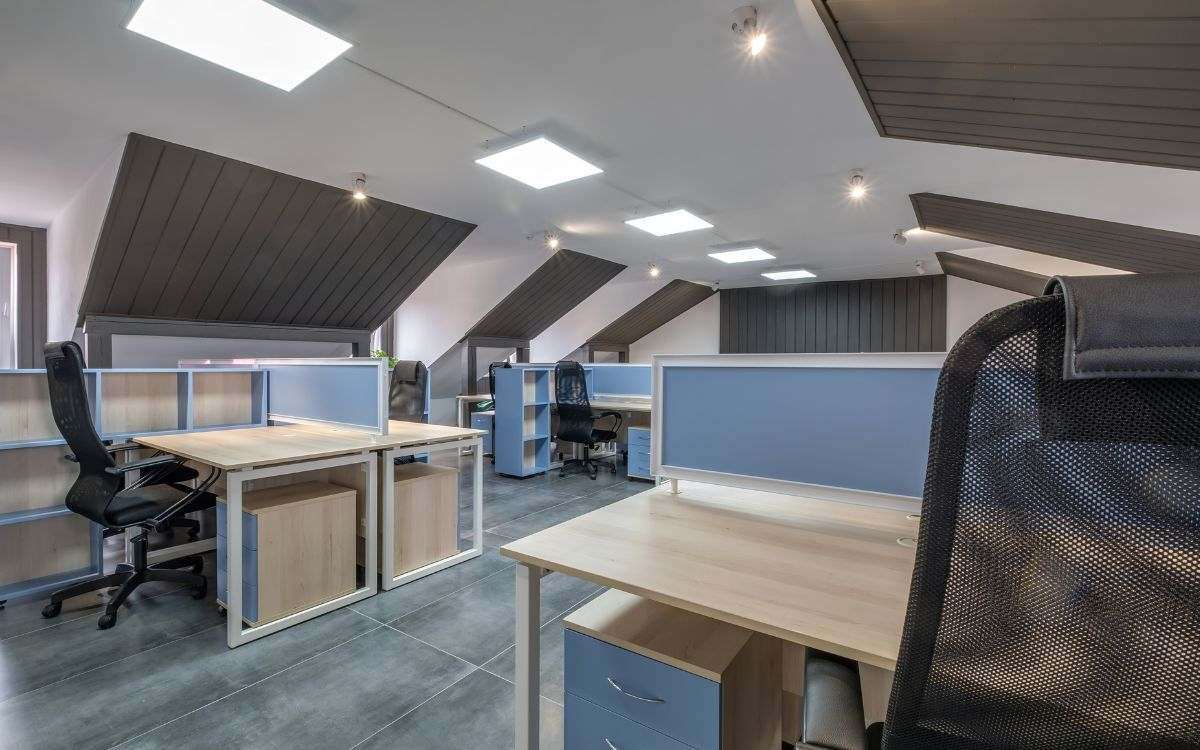
Installation of the 60x60 LED panel in a suspended ceiling is the most widely used system in office buildings and commercial premises. Compatible with standard Armstrong ceilings, it allows direct replacement of fluorescent fittings without additional building work. If you are looking for a recessed 60x60 LED panel, this is the default installation.
Surface-mount kit for a 60x60 panel
Where there is no suspended ceiling, the surface-mount kit allows the panel to be fixed directly to the ceiling. Installation is quick and the finish blends in well. It is a common solution in refurbishments where no technical ceiling will be built.
You can check the accessories available in the panel accessories section.
Suspended pendant systems
Suspended systems give a more contemporary finish and are suitable for spaces with high ceilings, coworking areas or design-led spaces.
Applications by type of business
60x60 LED panel for offices
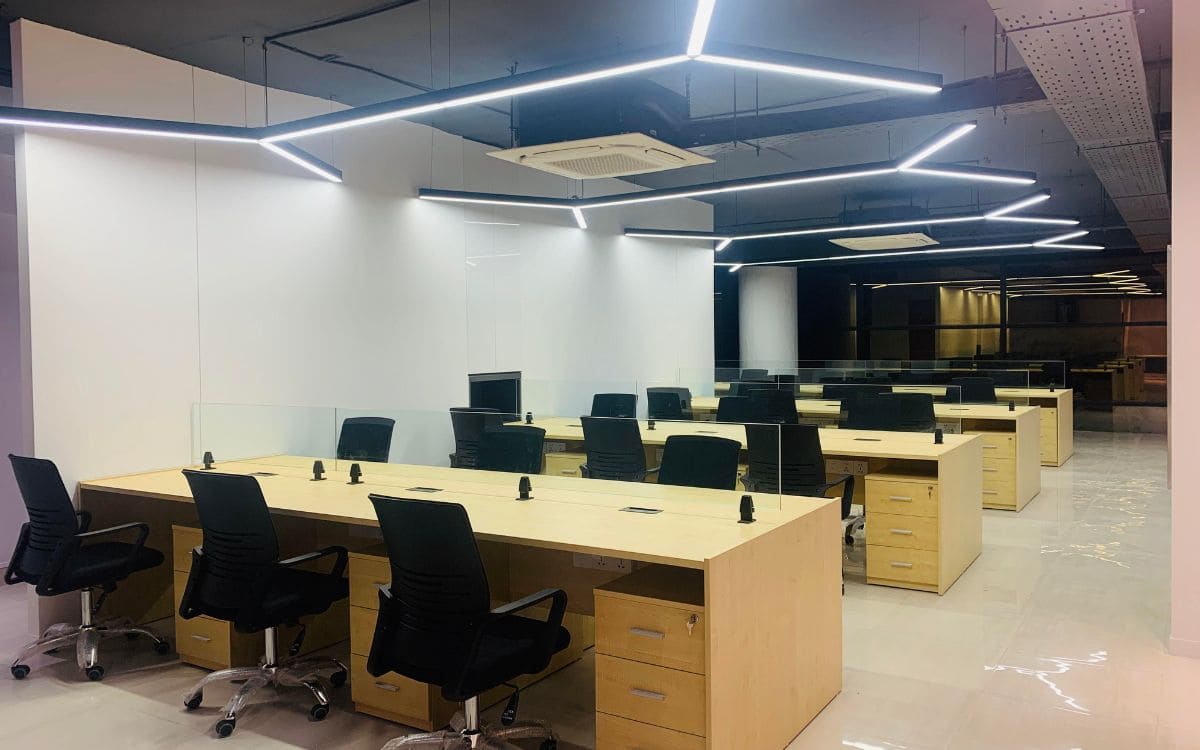
The 60x60 LED panel for offices must meet three non-negotiable requirements: UGR19 or below, 4000K colour temperature and uniform light distribution. Any model that does not state the UGR value on its datasheet should be ruled out for this use.
60x60 LED panel for shops and retail spaces
The 60x60 LED panel for shops needs a higher luminous flux than the standard office panel, a good colour rendering index (CRI above 80, preferably 90) and a design that does not detract from the product on display. Uniform lighting across the space here improves customer perception and reduces dead zones on the shop floor.
60x60 LED panel for schools and healthcare facilities
In these environments, visual comfort is a functional requirement, not a preference. Complete absence of flicker, high energy efficiency and, in most cases, CE ENEC certification are required, as a guarantee that the product has passed independent safety and performance tests.
How to compare models: what to look at beyond the price
Philips driver vs standard driver
The 60x60 LED panel with Philips driver is the benchmark in professional installations. Here is the specific difference:
| Feature | Standard driver | Philips driver |
| Stability | Medium | High |
| Flicker | Possible | No flicker |
| Service life | Standard | Higher |
| Warranty | 2 years | Up to 5 years |
For bulk purchases, the 60x60 LED panel pack of 10 units brings the unit cost down and simplifies order management, which makes it the usual choice for B2B projects. Check the full LED panel catalogue for availability and references.
Warranty and service life
Before deciding on a 60x60 LED panel by price alone, it is worth comparing the total cost. A cheaper model per unit with a standard driver may end up more expensive in maintenance after two years. For bulk purchases, the 60x60 LED panel pack of 10 units brings the unit cost down and simplifies order management. Check the full LED panel catalogue for availability and references.
Conclusion and purchasing recommendation
Price is the most visible criterion, but rarely the most relevant. To choose a 60x60 LED panel properly, you have to check the UGR value, the type of driver, the actual lumens and the installation system available in the space.
The best 60x60 LED panel for value is not the cheapest per unit but the one that brings down maintenance costs in the long run. A panel with a Philips driver, UGR19 and CE ENEC certification meets that criterion.
To buy a 60x60 LED panel with technical guarantees, take a look at the LED panel catalogue from Ibérica de Iluminación or request a quote for projects with volume.
Frequently asked questions about 60x60 LED panels
How many watts should a 60x60 LED panel have?
The most common figure is 40W, but power alone does not tell the whole story. What matters is the actual luminous flux in lumens. A 36W panel with good performance can deliver more useful light than a 48W one of low quality.
What is the difference between a slim panel and a framed one?
The slim is thinner, lighter and has a cleaner finish. The framed panel is sturdier and is designed for installations with greater mechanical demands. For offices and shops, the slim is the standard option.
Can I install a 60x60 LED panel without a suspended ceiling?
Yes. There are surface-mount kits that allow the panel to be fixed directly to the ceiling, and also suspended pendant systems for high ceilings. Both are available as separate accessories.
Which driver is better for a dimmable LED panel?
For professional use, the Philips driver is the most solid option: greater stability, no flicker and up to five years of warranty. It is the usual benchmark when dimming has to work without incident for years.
What does UGR19 mean on an LED panel?
It indicates that the glare level is below the threshold of 19, which is the maximum recommended value for workstations with screens. Above that value, visual fatigue increases. It is a regulatory requirement in many office and shop lighting projects.
Are 60x60 LED panels suitable for replacing fluorescents?
Yes, they are designed specifically for that. They are compatible with the openings of standard suspended ceiling modules and the changeover is direct in most installations.
How long does a quality 60x60 LED panel last?
Up to 50,000 hours, although the real figure depends on the driver and the conditions of use. A panel with a Philips driver and CE ENEC certification has a better chance of reaching that figure.
Posted in:
Sample Category
Related posts
A practical guide to choosing the perfect LED lighting for your office
Find out how to choose the perfect LED lighting for your office: it complies with the EN 12464 standard, boosts your...
Read more
Slim recessed LED downlights: guide to models, wattages and prices
Discover the differences between circular and square models, available wattages from 6W to 26W, key features such as...
Read more
LED colour temperature: how to choose between 2700K, 4000K and 6500K for your space
Warm, neutral or cool light: each LED colour temperature has its ideal space. We explain the differences between...
Read more
LED track spotlights for shops: single-phase vs three-phase, models and installation keys
Single phase or three-phase? Choosing the right LED track system makes the difference between a well-lit shop and one...
Read more
LED Lighting for Shops: Light Strategies That Drive Sales
Discover how LED lighting boosts shop sales: lux levels by zone, CRI, colour temperature and common mistakes to avoid...
Read more
Search in blog
Blog categories
Latest posts
COB vs SMD LED Strips: Technical Differences and When to Use Each Technology
Read more
24V DC LED Strips: The Professional Choice for High-Brightness, Long-Run Installations
Read more
24V DC LED strips allow long runs to be installed without voltage drop or colour variation. Discover the available...
LED Lighting for Car Parks and Garages: Regulations, Luminaires and Maximum Energy Savings
Read more
LED lighting for car parks and garages allows lighting consumption to be reduced by up to 80 % using presence...
LED IP65 and IP66 Battens and Weatherproof Diffusers: A Model Guide for Damp and Industrial Areas
Read more
This guide compares IP65 and IP66 weatherproof LED diffusers by power, chip and length, and shows which model is best...
Complete Guide to Replacing Fluorescent Lights with LED: Steps, Equivalents and Real Savings
Read more
This guide explains how to replace fluorescent lights with LED step by step, with power equivalents, ballast bypass...
Popular posts
60x60 LED panels: everything you need to know before buying
Discover how to choose the ideal 60x60 LED panel for your project. We compare drivers, wattages, installation types...
Read more
A practical guide to choosing the perfect LED lighting for your office
Find out how to choose the perfect LED lighting for your office: it complies with the EN 12464 standard, boosts your...
Read more
LED colour temperature: how to choose between 2700K, 4000K and 6500K for your space
Warm, neutral or cool light: each LED colour temperature has its ideal space. We explain the differences between...
Read more

LED public lighting: current regulations, technical requirements and key points for compliance
Guide to Spain's LED public lighting regulations: technical requirements, road classes, parameters and mandatory...
Read more
Slim recessed LED downlights: guide to models, wattages and prices
Discover the differences between circular and square models, available wattages from 6W to 26W, key features such as...
Read more
Leave a comment