We compare COB vs SMD LED strips to help you choose the right technology for each project. We analyse light...
.svg)

LED Lighting for Shops: Light Strategies That Drive Sales
An entrepreneur opened her first boutique in Bilbao; the premises were lovely but sales were flat. A relative told her about led lighting that increases sales and she decided to look into it.
She swapped her fluorescent tubes for track spotlights at 3000K with high CRI and added two ambient panels. Within three weeks, customers were lingering longer and buying more.
Led lighting for shops is not an infrastructure cost, it is a sales tool. Knowing how to light a shop to sell more means understanding how light shapes a customer's perception, journey and purchase decision.
Lighting as a sales tool
Led lighting in retail commerce has shown for years that the same item under a quality light source looks more valuable and appealing than under a generic fluorescent. A well-lit point of sale builds greater trust in the customer experience, longer dwell time and higher conversions.
What neuromarketing says about light
Neuromarketing in retail lighting shows that light triggers emotional responses before the customer is even aware of them. Warm-light environments favour emotional buying decisions. Cool light sources are associated with functional, rational settings.
The perceived value of a product under light rises directly when there is contrast between general lighting and accent lighting. Light-and-shadow contrast in the shop window applies this principle outside. A well-lit composition set against a darker backdrop communicates price and quality before the customer even crosses the threshold. The ambient temperature in shopping also has an effect: bright environments free of glare extend the time spent inside the premises.
The customer journey and lighting hierarchy
The customer journey through lighting is shaped by using light to create visual hierarchies. If you point accent light on a product in a led-lit shop at high-margin items or new arrivals, you are influencing buying behaviour invisibly. Sound lighting planning can lift the area of the shop visited by between 20% and 40%.
Recommended lighting levels by zone
Making the light uniform across the whole shop is the most common mistake. Recommended lux levels for sales zones vary according to the function of each area. The commercial lighting standard (UNE-EN 12464-1) sets minimums that optimum sales values routinely exceed:
- General circulation: 300-500 lux
- Shelving and displays: 500-1,000 lux
- Shop window and featured product: 1,500-3,000 lux
- Fitting rooms: 500-800 lux, wrap-around light with no harsh shadows
- Till area: 400-600 lux, warm tone
Shop window: the first visual impact
Led shop window lighting is the first conversation the premises has with the customer. On a street with strong daylight, the window needs at least 1,500 lux to compete visually.
Adjustable track spotlights let you redirect the light every time the composition changes, without touching the wiring.
Product area, shelving and fitting rooms
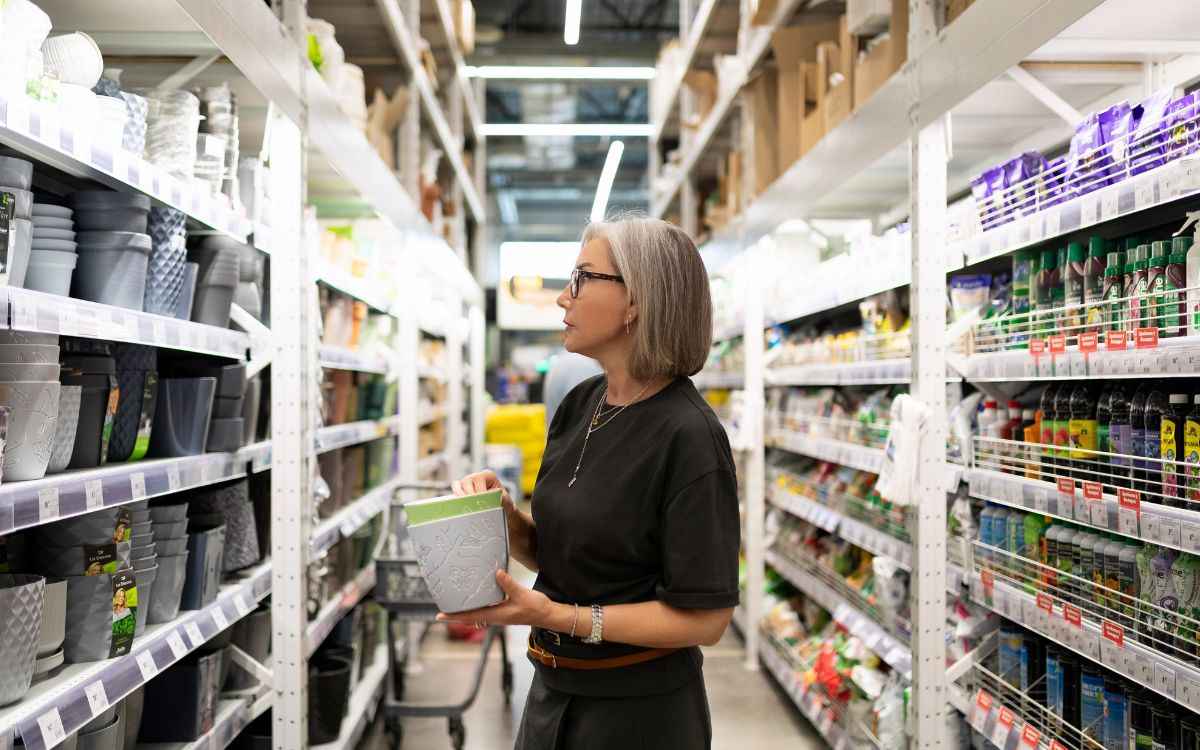
For led light for a clothes shop, the customer needs to see the real colour and texture of the fabric before deciding to try it on. Energy efficiency in a commercial unit brings in luminaires above 100 lm/W that maintain high levels without driving up energy consumption. Energy savings in a led-lit shop versus halogen or fluorescent can exceed 60%.
In the fitting rooms, wrap-around light on both sides of the mirror between 3000K and 3500K with a minimum CRI of 90. If the customer looks good, they buy. An overhead, cool spotlight in this area is one of the most expensive mistakes in retail.
Which LED luminaires to choose for each zone
Led spotlights for fashion shops with high CRI are the standard in fashion and jewellery: adjustable, expressive and able to create visual hierarchy without touching the installation. For a well-executed led commercial lighting project, the ideal angle of incidence sits between 30° and 45°.
Led panels for shops and supermarkets and for any retail outlet handle background lighting efficiently. On their own they do not create hierarchy, but they provide the base level on which accent lighting works. A panel with efficiency above 110 lm/W and a 50,000-hour service life cuts maintenance significantly.
For aisles and transit zones, a neutral downlight from 9W to 18W does the job without competing with accent lighting.
CRI: colour rendering and visual fidelity
Colour rendering and visual fidelity is what separates a shop that shows its products well from one that distorts them. CRI in textiles, food and jewellery follows the same logic across the three sectors with different thresholds. CRI 90-92 minimum for textiles, CRI 90 for food and fresh produce, CRI 95-98 for jewellery and optical retail.
Led lighting for jewellery shops is the most demanding in retail. It calls for a higher colour temperature of 4000K-5000K and maximum CRI so that gemstones sparkle and metals show their true colour. A low CRI here triggers immediate returns and erodes customer trust.
Colour temperature by sector
The colour temperature for retail shops depends on the product and the emotion you want to evoke:
- Fashion and textiles: 3000K, warm and intimate, favours emotional decisions.
- Supermarkets and food: 3500K-4000K, reinforces the perception of hygiene and freshness.
- Jewellery and optical: 4000K-5000K with CRI 95+, makes metals and gemstones sparkle.
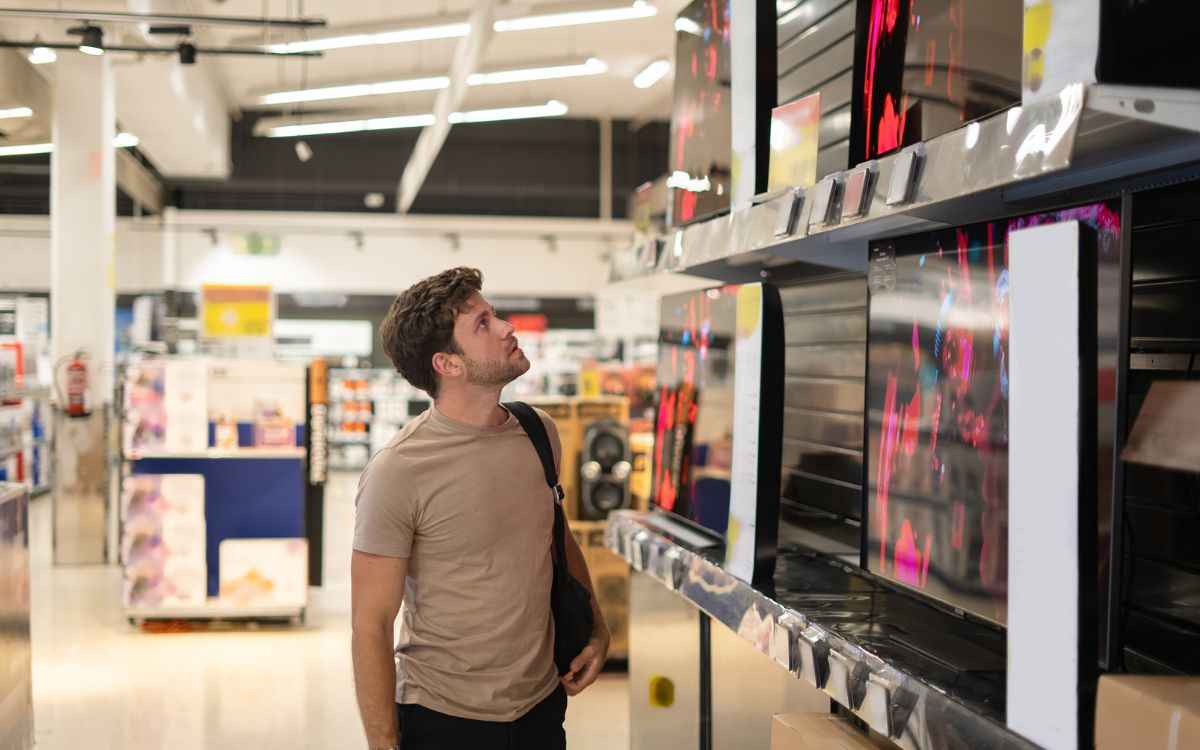
- Electronics: led lighting for electronics shops also works at 4000K-5000K, reinforcing the perception of technological precision.
How to plan the lighting in your premises
A well-planned led commercial lighting project begins with an analysis of the space, not with a catalogue. Some suppliers offer a complete shop lighting kit track, spotlights and panels as a starting point, but the optimum approach is to size each zone independently.
The cost of lighting a 100 m² shop with LED runs from €1,500 for a basic option. It can pass €8,000 in a technical project with scene control. Energy savings against older technologies pay back the investment in under three years in most cases.
Common mistakes worth avoiding
- Making the light level uniform across the whole shop: it removes visual hierarchy and flattens the experience.
- Ignoring the CRI when buying: the cheapest luminaires usually have a low CRI, with a direct cost in sales.
- Overhead spotlights in fitting rooms: the worst possible shadows at the most decisive moment.
- Mixing colour temperatures without a clear rationale: it creates incoherence that the customer picks up on even without identifying it.
- Not allowing for technical track from the outset: adding it after a refit multiplies the cost.
Frequently asked questions about LED lighting for shops
How many lux does a shop need to meet the standard?
UNE-EN 12464-1 requires a minimum of 300 lux in general sales areas. To maximise sales, displays should sit between 500 and 1,000 lux, with accent points that can reach 2,000-3,000 lux in the shop window.
What CRI is recommended for clothes shops?
Minimum CRI 90, optimum CRI 92-95. Below 85, fabrics are distorted and the customer may be disappointed when seeing the product at home.
Which colour temperature sells most in retail?
It depends on the sector: 3000K for fashion, 3500K-4000K for food, 4000K-5000K for jewellery and electronics. There is no universal temperature.
How much will I save if I switch to LED in my shop?
Between 50% and 70% in energy consumption. In premises with 10-12 hours of opening time a day, the return on investment usually comes through between 18 months and 3 years.
What is accent lighting and how do you use it?
It consists in directing a concentrated point of light at a specific object, creating a contrast of 3:1 to 5:1 with the general surroundings. The usual tool is an adjustable track spotlight with a narrow angle (15°-24°).
Can I have a bespoke project for my premises?
Yes. It includes lux calculations by zone, luminaire selection, simulation with specialised software and installation advice. It is the most efficient way to make sure the investment is properly sized.
How much does it cost to light a 100m² shop with LED?
A basic solution sits at around €1,500-3,000 in materials. A full technical project can come in between €5,000 and €9,000. Energy savings pay back the difference in under three years.
Posted in:
Sample Category
Related posts
60x60 LED panels: everything you need to know before buying
Discover how to choose the ideal 60x60 LED panel for your project. We compare drivers, wattages, installation types...
Read more
A practical guide to choosing the perfect LED lighting for your office
Find out how to choose the perfect LED lighting for your office: it complies with the EN 12464 standard, boosts your...
Read more
Slim recessed LED downlights: guide to models, wattages and prices
Discover the differences between circular and square models, available wattages from 6W to 26W, key features such as...
Read more
LED colour temperature: how to choose between 2700K, 4000K and 6500K for your space
Warm, neutral or cool light: each LED colour temperature has its ideal space. We explain the differences between...
Read more
LED track spotlights for shops: single-phase vs three-phase, models and installation keys
Single phase or three-phase? Choosing the right LED track system makes the difference between a well-lit shop and one...
Read more
Search in blog
Blog categories
Latest posts
COB vs SMD LED Strips: Technical Differences and When to Use Each Technology
Read more
24V DC LED Strips: The Professional Choice for High-Brightness, Long-Run Installations
Read more
24V DC LED strips allow long runs to be installed without voltage drop or colour variation. Discover the available...
LED Lighting for Car Parks and Garages: Regulations, Luminaires and Maximum Energy Savings
Read more
LED lighting for car parks and garages allows lighting consumption to be reduced by up to 80 % using presence...
LED IP65 and IP66 Battens and Weatherproof Diffusers: A Model Guide for Damp and Industrial Areas
Read more
This guide compares IP65 and IP66 weatherproof LED diffusers by power, chip and length, and shows which model is best...
Complete Guide to Replacing Fluorescent Lights with LED: Steps, Equivalents and Real Savings
Read more
This guide explains how to replace fluorescent lights with LED step by step, with power equivalents, ballast bypass...
Popular posts
60x60 LED panels: everything you need to know before buying
Discover how to choose the ideal 60x60 LED panel for your project. We compare drivers, wattages, installation types...
Read more
A practical guide to choosing the perfect LED lighting for your office
Find out how to choose the perfect LED lighting for your office: it complies with the EN 12464 standard, boosts your...
Read more
LED colour temperature: how to choose between 2700K, 4000K and 6500K for your space
Warm, neutral or cool light: each LED colour temperature has its ideal space. We explain the differences between...
Read more
LED public lighting: current regulations, technical requirements and key points for compliance
Guide to Spain's LED public lighting regulations: technical requirements, road classes, parameters and mandatory...
Read more
Slim recessed LED downlights: guide to models, wattages and prices
Discover the differences between circular and square models, available wattages from 6W to 26W, key features such as...
Read more
Leave a comment