Surface-mounted LED downlights solve the lack of a false ceiling. Compare ceiling lights, slim panels, finishes and...
.svg)

LED track spotlights for shops: single-phase vs three-phase, models and installation keys
The owner of a fashion shop in a shopping centre was renovating his premises when the installer suggested fitting three-phase tracks. He didn't understand the difference from single-phase tracks or why it was worth the extra cost.
After having it explained to him, he saw that with 15 spotlights of 40W and CRI92 on a three-phase track he could manage three independent circuits and reposition the spotlights each time without touching the wiring.
He ended up ordering spotlights, tracks and accessories. The result spoke for itself: the garments looked exactly as they were and customers spent more time in the shop.
That same decision is the one facing any retailer that wants professional, flexible and cost-effective lighting. Here are the keys to choosing the right LED track spotlights for your shop.
Why track spotlights are the best option for lighting shops
LED track systems have become the retail standard for very specific reasons. Compared with recessed downlights or fixed luminaires, they offer a combination of versatility, power and aesthetics that suits any commercial format. LED accent lighting for fashion shops is better resolved with track spotlights than with any other system.
Flexibility and repositioning without building work
A track allows you to add, remove or move spotlights along its entire length without drilling new holes in the ceiling. The flexibility to reposition spotlights when the product layout changes or a new collection arrives means you simply slide the spotlight to another position and reorient it. No need to hire an electrician or anything else. All models carry IP20 certification for indoor use, designed for climate-controlled commercial spaces.
Accent lighting that enhances the product
The track spotlight is the tool for creating focal accent lighting on the product. A well-directed beam onto a mannequin, a display unit or a seasonal table generates visual contrast, draws the eye and increases the perception of value. That ability to highlight specific pieces is what separates a flat shop from one that sells with light.
Difference between single-phase and three-phase track
The difference between single-phase and three-phase LED track is the first technical decision you need to make. Both serve the same purpose — powering spotlights along a profile — but their electrical architecture completely changes the control possibilities.
| Feature | Single-phase | Three-phase |
| Independent circuits | 1 | 3 |
| Zone control | No | Yes |
| Maximum load per circuit | Limited | Distributed across 3 lines |
| Price | More economical | Slightly higher |
| Recommended use | Small shops | Medium and large shops |
When to choose single-phase track
Single-phase track has a single circuit. All connected spotlights switch on and off together. It is the simplest and most economical option for small shops where differentiated scenes are not needed. A single-phase LED track spotlight for shops of 30W covers a neighbourhood shop or a compact showroom perfectly well.
When to choose three-phase track
Three-phase track integrates three independent circuits within a single profile. It allows you to assign each spotlight to a different circuit and create separate lighting scenes.
For example, having an accent lighting system in the window display, general lighting in the sales area and ambient lighting at the counter. The three-phase power supply is distributed across the three circuits, which prevents overloads when you install many powerful spotlights. Powerful three-phase LED track spotlights are the benchmark for medium and large shops.
Compatibility between spotlights and tracks
A single-phase spotlight does not fit a three-phase track and vice versa. The connection adaptor is different.
If your project has more than 8–10 spotlights or you foresee growth and future extensions, invest in three-phase from the outset. The three-phase LED track spotlight price is only slightly higher and the versatility more than makes up for it.
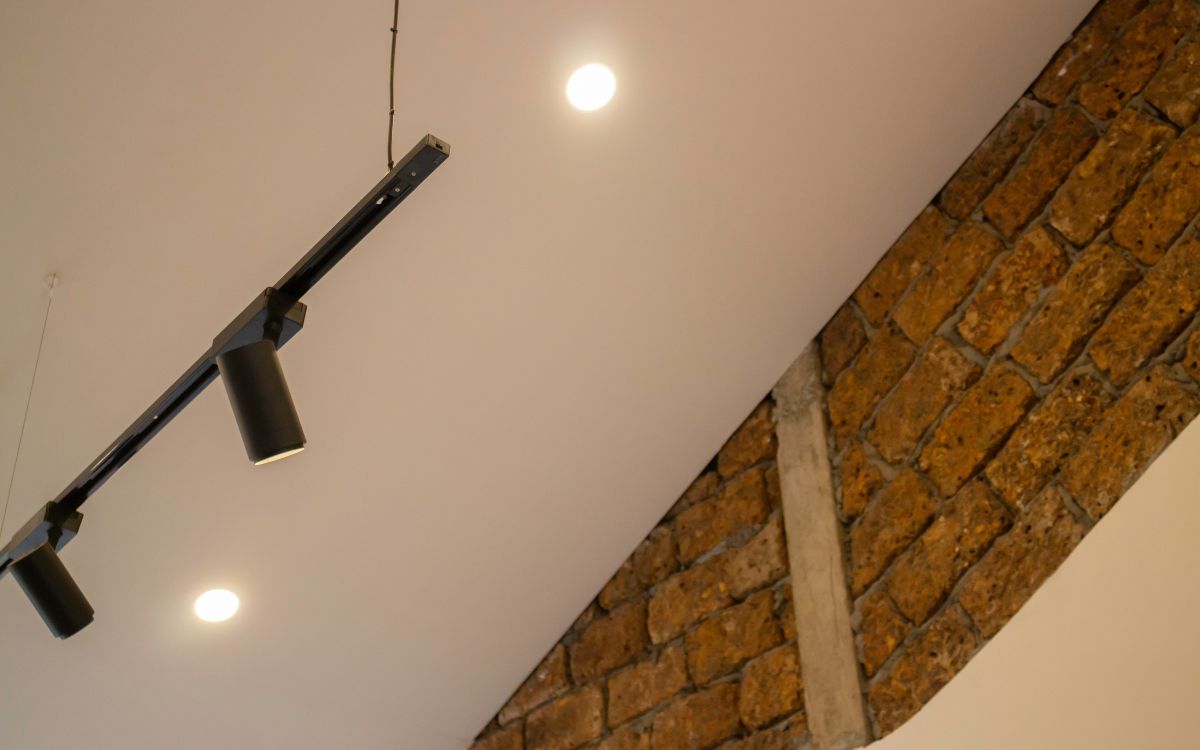
How to choose the right LED track spotlight
Choosing a track spotlight is not just about wattage. LED track lighting for clothing, jewellery or food retail demands specific criteria for each one.
Wattage and luminous flux according to floor area
As a general rule, calculate 1 spotlight every 3–4 m² for accent lighting. A 40W CRI90 LED track spotlight delivers between 3,200 and 4,000 lumens, enough to cover a focal point at a mounting height of 2.5–3 metres. For large shops or high ceilings, move up to 50W.
High CRI for clothing, jewellery and food
Colour rendering for textiles depends directly on CRI. For fashion retail, jewellery or fresh food, the professional minimum is CRI 90. Below that, reds look dull and subtle tones are lost. A spotlight with a high-luminosity Bridgelux chip and CRI92 or above is the benchmark used by serious retail chains.
Beam angle: 24° accent vs 36° general
The 24° and 36° beam angle defines the type of lighting you achieve:
- 24°: concentrated beam, ideal for pure accent on mannequins, display units or jewellery pieces.
- 36°: wider beam, perfect for washing broader areas such as clothing rails or shelving.
It is common practice to combine both angles in the same installation. An adjustable LED track spotlight allows you to change the beam direction without swapping the luminaire.
Dimming and DALI control
If you want to control the intensity of each spotlight or programme timed scenes, you need a DALI dimmable LED track spotlight. The DALI protocol allows you to manage each luminaire individually from a central controller. Not all track spotlights are compatible, so check the technical data sheet. UGR glare control also improves when you can adjust the output according to the time of day and available natural light.
Installing the LED track system
Knowing how to connect LED track spotlights doesn't require a master's degree in electrical engineering, but you do need to know the components and mounting options.
Types of accessories: I, L and T connectors
Tracks are joined together using connectors that allow you to create straight or corner layouts:
- I-type connector: joins two sections in a straight line.
- L-type connector: 90° turn.
- T-type connector: three-way junction.
Each I, L and T track connector must be compatible with the system (single-phase or three-phase). Tracks are manufactured in standard lengths of 1 metre and 2 metres, which are combined to cover any distance.
Suspension kits and mounting options
The track can be installed in three configurations depending on the ceiling:
- Surface-mounted: screwed directly to the ceiling. The quickest option.
- Suspended: hung from cables or rods. Ideal for high ceilings or warehouse-type spaces.
- Recessed: built into the false ceiling for a clean finish.
A recessed, surface-mounted or suspended track is chosen based on the shop's aesthetics and available height. For plasterboard ceilings, it is recommended to use load-specific fixings. A complete LED track kit for shops typically includes the track, connectors, end caps and the power feed.
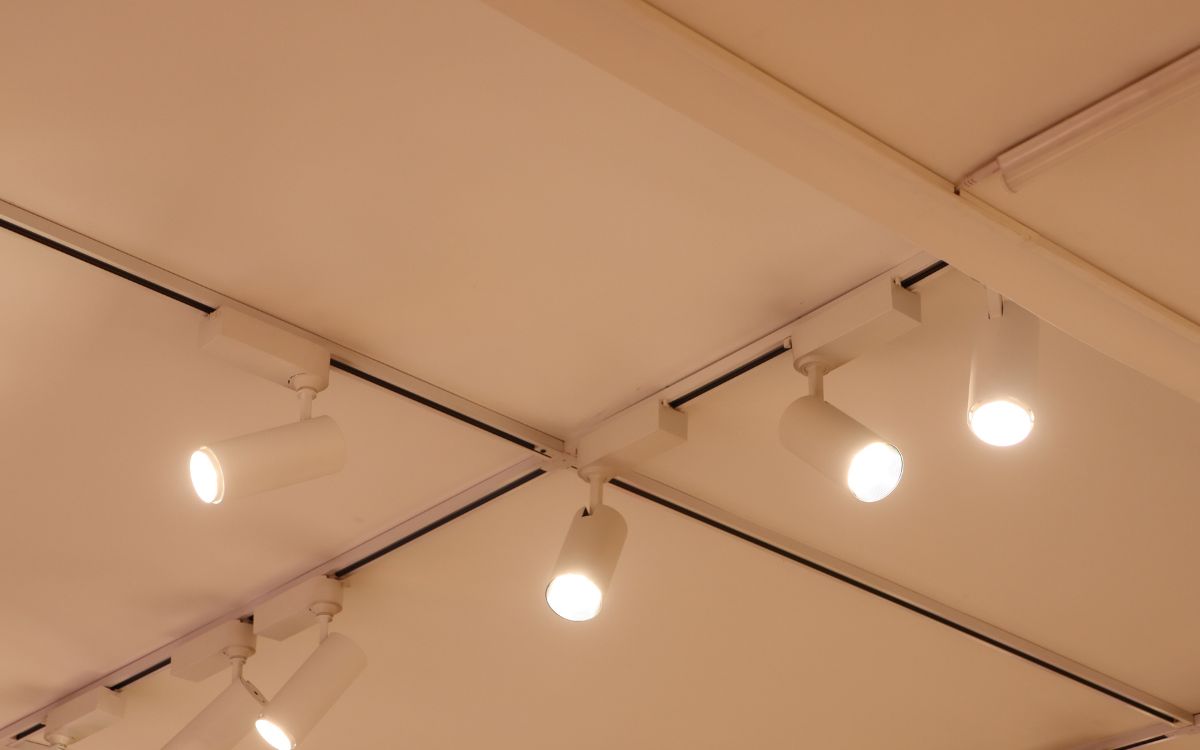
Featured models from the catalogue for shops
At Ibérica de Iluminación we work with track spotlights in black and white LED track spotlight finishes to suit any interior design. The most popular models for retail combine a Bridgelux chip LED track spotlight with a high-quality driver and an oversized aluminium heat sink. For LED accent lighting projects in fashion shops we recommend 30–40W spotlights with CRI92 and a 24° beam angle, mounted on three-phase track.
To install LED track spotlights in your shop, browse our selection of models with detailed technical data sheets showing UGR, CRI, wattage and track compatibility at the best guaranteed price.
How many spotlights do I need for my shop
The general rule for installing LED track spotlights in a shop is to calculate 1 accent spotlight every 3–4 m² of sales floor. A 50 m² shop will need between 12 and 16 spotlights, depending on ceiling height and the number of focal points you want to create. If you combine them with general lighting such as panels or linear luminaires, you can reduce the number of accent spotlights and concentrate them on your star products.
Frequently asked questions about LED track spotlights for shops
How many track spotlights do I need for a 50 m² shop?
Between 12 and 16 accent spotlights, at a rate of 1 spotlight every 3–4 m². The exact number depends on ceiling height, furniture layout and whether you supplement with general lighting.
Can I mix spotlights from different brands on the same track?
Yes, provided they are the same track type (single-phase or three-phase). The connection adaptor must match. Mixing different colour temperatures or CRI values in the same space is not recommended.
What is the difference between single-phase and three-phase track?
Single-phase has a single circuit: all spotlights operate together. Three-phase offers three independent circuits to create separate lighting scenes and distribute the electrical load more effectively.
What CRI do I need to light clothing or jewellery?
CRI 90 as a minimum. For jewellery and garments with complex colours, a CRI of 93–95 makes a visible difference in colour rendering.
Are LED track spotlights dimmable?
Not all of them. DALI dimmable models allow individual intensity control. Check the technical data sheet to confirm whether the spotlight is compatible with dimming before purchasing.
What accessories do I need to install an LED track?
As a minimum, the track, a power feed end cap, blind end caps for the ends and I, L or T connectors depending on the layout. If suspended mounting is required, add the suspension kit.
Can an LED track be installed on a plasterboard ceiling?
Yes. It is recommended to use plasterboard expansion fixings or, better still, to anchor the track directly to the metal profiles of the framework. The weight of a track with spotlights does not usually exceed 5–6 kg per linear metre.
Posted in:
Sample Category
Related posts
60x60 LED panels: everything you need to know before buying
Discover how to choose the ideal 60x60 LED panel for your project. We compare drivers, wattages, installation types...
Read more
A practical guide to choosing the perfect LED lighting for your office
Find out how to choose the perfect LED lighting for your office: it complies with the EN 12464 standard, boosts your...
Read more
Slim recessed LED downlights: guide to models, wattages and prices
Discover the differences between circular and square models, available wattages from 6W to 26W, key features such as...
Read more
LED colour temperature: how to choose between 2700K, 4000K and 6500K for your space
Warm, neutral or cool light: each LED colour temperature has its ideal space. We explain the differences between...
Read more
LED Lighting for Shops: Light Strategies That Drive Sales
Discover how LED lighting boosts shop sales: lux levels by zone, CRI, colour temperature and common mistakes to avoid...
Read more
Search in blog
Blog categories
Latest posts
Surface-mounted LED downlights: ceiling lights and slim panels for ceilings without building work
Read more
Linear LED lighting for hospitality: ideas and solutions for bars, restaurants and hotels
Read more
Linear LED lighting sets the mood in bars, restaurants and hotels. Discover the types of luminaires, key areas and...
Aluminium profiles for LED strips: types, diffusers and how to choose the right mounting
Read more
Discover the aluminium profiles available for LED strips, which diffuser to choose and what accessories you need for...
LED vs halogen: complete comparison of performance, savings and light quality
Read more
Is it worth switching your bulbs? This LED vs halogen comparison covers energy consumption, lifespan, heat and light...
E27 LED Bulbs: direct replacement guide by shape, wattage and colour temperature
Read more
Practical guide to replacing your old bulbs with E27 LED bulbs without complications. Learn how to choose shape,...
Popular posts
60x60 LED panels: everything you need to know before buying
Discover how to choose the ideal 60x60 LED panel for your project. We compare drivers, wattages, installation types...
Read more
A practical guide to choosing the perfect LED lighting for your office
Find out how to choose the perfect LED lighting for your office: it complies with the EN 12464 standard, boosts your...
Read more
LED colour temperature: how to choose between 2700K, 4000K and 6500K for your space
Warm, neutral or cool light: each LED colour temperature has its ideal space. We explain the differences between...
Read more

LED public lighting: current regulations, technical requirements and key points for compliance
Guide to Spain's LED public lighting regulations: technical requirements, road classes, parameters and mandatory...
Read more
Slim recessed LED downlights: guide to models, wattages and prices
Discover the differences between circular and square models, available wattages from 6W to 26W, key features such as...
Read more
Leave a comment