
We compare COB vs SMD LED strips to help you choose the right technology for each project. We analyse light...
.svg)

LED Strips vs Recessed Downlights: Which to Choose for Your Space and Needs
When the time comes to light a renovation, the question almost always comes up: LED strips vs downlights, which should I install? Each option follows a different logic, and choosing wrong means redoing work or living with lighting that does not work. Here we compare both so you can decide before buying.
Two lighting philosophies: direct vs indirect
The fundamental difference between LED strips and downlights is not aesthetic: it is functional. One directs the beam downwards; the other distributes light in a diffuse way.
What direct lighting with downlights offers
A recessed downlight projects light downwards with a beam angle ranging between 24° and 60°. That makes it a direct functional lighting tool: it concentrates lux at the work surface where they are needed.
The warm or neutral colour temperature you choose affects the final result. Warm white (2700-3000K) gives a residential feel; neutral white (4000K) is more common in kitchens and bathrooms. The CRI colour rendering index also matters: a CRI above 90 reproduces colours accurately, which is relevant in bathrooms or retail premises.
What indirect lighting with LED strips offers
LED strips work differently. Installed hidden inside a profile, behind a piece of furniture, or in a cornice, they produce diffuse ambient light. Light with no visible source that envelops the space.
The coving indirect lighting effect makes ceilings appear higher. A strip under a kitchen unit eliminates shadows on the worktop without adding any spotlight to the ceiling. Wattage consumption per linear metre varies between 4-5W/m for decorative applications and 12-15W/m for high-density strips.
Technical comparison of LED strips vs downlights: consumption, installation, and cost
Installation cost: with or without building work
This is the most practical difference. A recessed downlight requires opening the ceiling: marking, cutting, cabling, and finishing the surface. If the ceiling is already finished, that means building work.
LED strips allow installation without building work using an LED profile. The aluminium profile is fixed to the existing surface, the strip is inserted, and connected. For partial renovations or rented spaces, this advantage is decisive. The installation cost of an LED strip vs a downlight is clearly lower when no building work is involved.
| Criterion | LED strip | Recessed downlight |
|---|---|---|
| Requires ceiling work | No (with profile) | Yes |
| Reversible installation | Yes | No |
| Direct functional light | Limited | High |
| Ambient lighting | High | Low |
Energy consumption compared
For energy efficiency of strip vs downlight you need to consider where the light goes. A 7-10W downlight produces 600-900 lumens concentrated in one spot; if you need to illuminate a specific surface, it consumes less for the same useful result. If you need general ambient light, the strip can cover more area with fewer installation points.
Service life and maintenance
Both technologies are LED with a similar theoretical service life: 25,000-50,000 hours. The practical difference lies in access: a strip in a profile is replaced in minutes; a recessed downlight requires work on the ceiling.
When to use LED strips
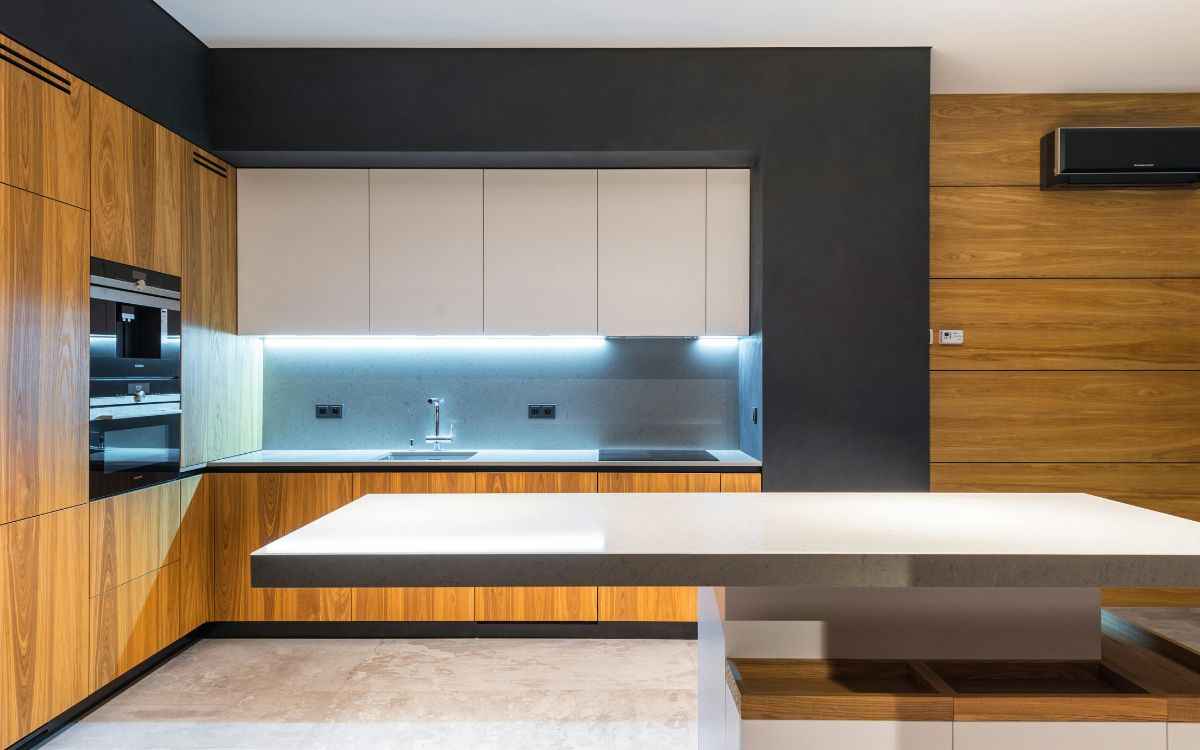
Under-cabinet kitchen lighting
The LED strip under kitchen units is one of the most established applications. The zone between the upper cabinets and the worktop tends to be in shadow with ceiling lighting. A strip in a profile under the wall units solves the problem without touching the ceiling.
Coving and suspended ceiling lighting
The coving perimeter tray effect with a hidden LED strip is the standard way to create decorative indirect light with an LED strip in living rooms and bedrooms. The light rises to the ceiling and spills to the sides, creating a soft layer that visually lifts the space. For this use, a profile with an opal diffuser is recommended. You can see the available models in our LED aluminium profiles category.
Decorative lighting in living rooms and bedrooms
In living rooms and bedrooms, indirect LED strip lighting vs direct downlight favours the strip when the aim is to create atmosphere. Behind a television, under the bed, or in a bookcase, the strip works as an accent with no visible spotlights. The full range is in the LED strips and flexible neon category.
When to use recessed downlights
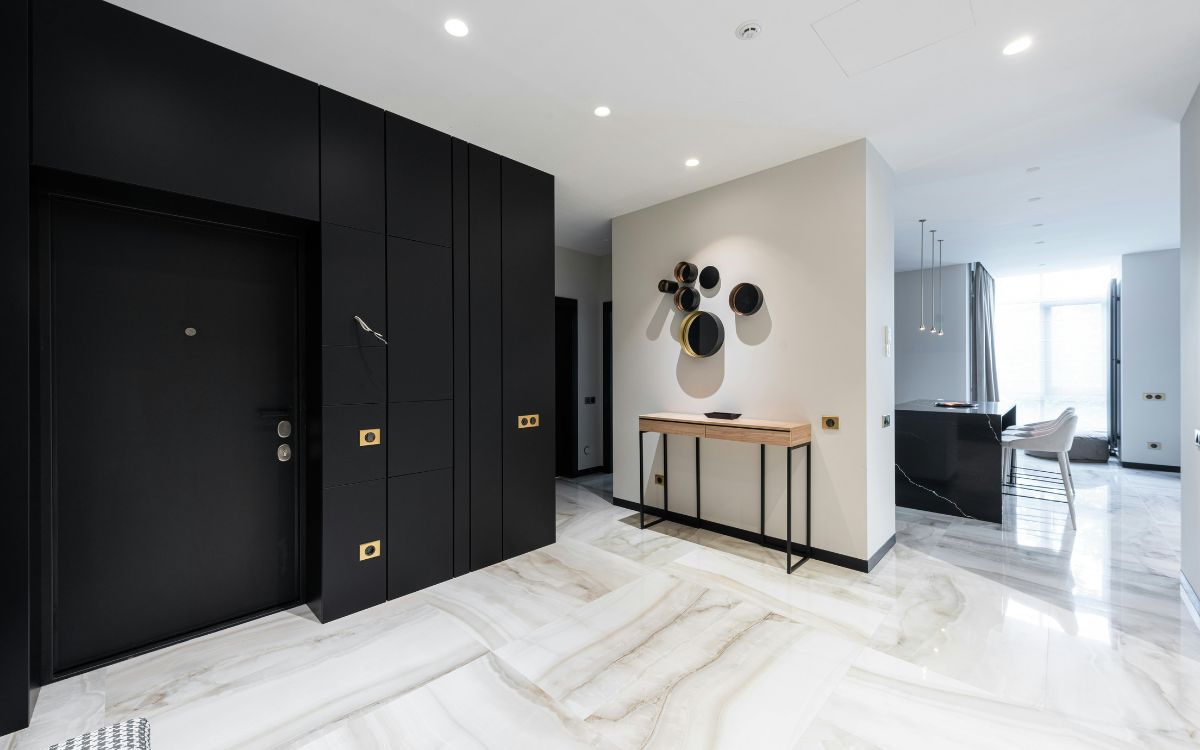
Functional lighting in kitchens and bathrooms
The downlight wins clearly where direct lux are needed. A 7-9W downlight well positioned illuminates the worktop or bathroom mirror without shadows.
If the question is LED strip or recessed spotlight for a kitchen, the best approach is to use both. The recessed spotlight for general functional light and the strip under the units for the worktop. In wet areas, the IP rating of the fitting must be verified.
General lighting in living rooms and hallways
For ambient vs functional LED lighting in hallways, the downlight provides orientation light without installing any profile.
The question of downlight or LED strip for a hallway almost always depends on the state of the ceiling. If it is already finished without trays, the downlight is the quickest and cleanest option. In living rooms, downlights vs LED strips: the downlight provides the functional layer, but the strip adds the atmosphere that spotlights cannot.
Commercial premises and offices
In offices and retail premises, the recessed downlight is the standard for practical reasons: integrated installation and direct light on work surfaces. A high-CRI downlight over a product has no easy substitute with indirect light. See the models in the slim LED downlight category.
The best solution combines both options
The LED strips vs downlights question starts from a premise worth questioning: they are not mutually exclusive. In most spaces, combining LED strips and downlights is the most efficient answer.
Layers of ambient, functional, and accent light
A well-resolved design has at least two layers. Combining light layers in a space allows the atmosphere to be controlled according to the use. Downlights provide the lux for tasks; LED strips add the ambient layer for relaxation or leisure.
Examples of combinations by room
| Room | Downlights | LED strips |
|---|---|---|
| Living room | 4-6 general spotlights | Perimeter coving + behind the TV |
| Kitchen | 4-8 spotlights over the worktop | Under upper units |
| Bedroom | 2-4 reading spotlights | Strip in headboard or under the bed |
| Bathroom | 2-4 spotlights above the mirror | Profile under the washbasin unit |
| Hallway | 3-5 linear spotlights | Optional: low night-light strip |
Conclusion and recommendation for your project
There is no single answer to the difference between LED strip and recessed downlight. It depends on the space, the ceiling, the budget, and the use of each area. The question of when to use an LED strip or a downlight has different answers depending on whether the aim is functional or ambient light.
If the ceiling is already finished, the downlight is the most efficient option for functional light. If you want atmosphere or flexibility, the LED strip in a profile is the better choice, and fitting an LED strip without building work requires nothing more than an aluminium profile screwed onto any surface.
If you can plan from scratch, combining both from the outset is the most cost-effective approach. The choice between LED strip or downlight for a bedroom, kitchen, or living room becomes straightforward once you are clear about the function of each light source.
Frequently asked questions about LED strips vs recessed downlights
Is an LED strip or a downlight better for lighting a kitchen?
It depends on the area. For the work surface a downlight delivers more lux per point. To eliminate shadows under the units, the LED strip under kitchen cabinets is the most practical solution.
Can I install LED strips without doing building work on the ceiling?
Yes. With an aluminium profile, installation without building work is possible on any surface with no chasing or plastering.
How much does an LED strip consume compared to a downlight?
Consumption in watts per linear metre varies between 4 and 15W/m. A standard downlight consumes 7-10W per point. For long surfaces the strip may consume more in total, but it also covers more area per installation.
What is coving lighting and how is it done?
The coving indirect lighting effect involves installing a hidden LED strip in a perimeter ceiling tray. The light bounces off the ceiling and creates a diffuse ambient layer with no visible light source.
Can LED strips and downlights be combined in the same room?
Yes. Combining light layers in a space with both sources is standard practice in well-designed installations.
Which option is cheaper to install?
The installation cost of an LED strip vs a downlight is lower for the strip with a profile and no building work. The downlight requires a hole to be cut and more electrician time.
Do LED strips provide enough light to illuminate an entire room?
It depends on the wattage. For ambient vs functional LED lighting in rooms, the most efficient approach is to combine strips with downlights rather than relying solely on indirect light.
Posted in:
Sample Category
Related posts
60x60 LED panels: everything you need to know before buying
Discover how to choose the ideal 60x60 LED panel for your project. We compare drivers, wattages, installation types...
Read more
A practical guide to choosing the perfect LED lighting for your office
Find out how to choose the perfect LED lighting for your office: it complies with the EN 12464 standard, boosts your...
Read more
Slim recessed LED downlights: guide to models, wattages and prices
Discover the differences between circular and square models, available wattages from 6W to 26W, key features such as...
Read more
LED colour temperature: how to choose between 2700K, 4000K and 6500K for your space
Warm, neutral or cool light: each LED colour temperature has its ideal space. We explain the differences between...
Read more
LED track spotlights for shops: single-phase vs three-phase, models and installation keys
Single phase or three-phase? Choosing the right LED track system makes the difference between a well-lit shop and one...
Read more
Search in blog
Blog categories
Latest posts
COB vs SMD LED Strips: Technical Differences and When to Use Each Technology
Read more
24V DC LED Strips: The Professional Choice for High-Brightness, Long-Run Installations
Read more
24V DC LED strips allow long runs to be installed without voltage drop or colour variation. Discover the available...
LED Lighting for Car Parks and Garages: Regulations, Luminaires and Maximum Energy Savings
Read more
LED lighting for car parks and garages allows lighting consumption to be reduced by up to 80 % using presence...
LED IP65 and IP66 Battens and Weatherproof Diffusers: A Model Guide for Damp and Industrial Areas
Read more
This guide compares IP65 and IP66 weatherproof LED diffusers by power, chip and length, and shows which model is best...
Complete Guide to Replacing Fluorescent Lights with LED: Steps, Equivalents and Real Savings
Read more
This guide explains how to replace fluorescent lights with LED step by step, with power equivalents, ballast bypass...
Popular posts
60x60 LED panels: everything you need to know before buying
Discover how to choose the ideal 60x60 LED panel for your project. We compare drivers, wattages, installation types...
Read more
A practical guide to choosing the perfect LED lighting for your office
Find out how to choose the perfect LED lighting for your office: it complies with the EN 12464 standard, boosts your...
Read more
LED colour temperature: how to choose between 2700K, 4000K and 6500K for your space
Warm, neutral or cool light: each LED colour temperature has its ideal space. We explain the differences between...
Read more

LED public lighting: current regulations, technical requirements and key points for compliance
Guide to Spain's LED public lighting regulations: technical requirements, road classes, parameters and mandatory...
Read more
Slim recessed LED downlights: guide to models, wattages and prices
Discover the differences between circular and square models, available wattages from 6W to 26W, key features such as...
Read more
Leave a comment