Learn how to choose a three-phase track spotlight for a shop or art gallery with the Uppsala CRI 98 and the Graz...


LED drivers and 24V power supplies: which one you need for each luminaire and how to choose without mistakes
Anyone searching for an LED driver 24V power supply in a catalog tends to mix up two devices that do not do the same job. If the wrong one is chosen, the luminaire flickers, switches itself off or dies within a few months.
It is the most frequent mistake among installers who do not work with technical lighting every day. Ibérica de Iluminación sells Philips Xitanium and Lifud drivers, and Gxtronic 24V power supplies.
LED driver 24V power supply: what is the difference between a driver and a power supply
Both devices convert the mains alternating current into direct current, and that is where the similarity ends. A driver controls the current that reaches the LED. A power supply controls the voltage.
Driver for constant current luminaires
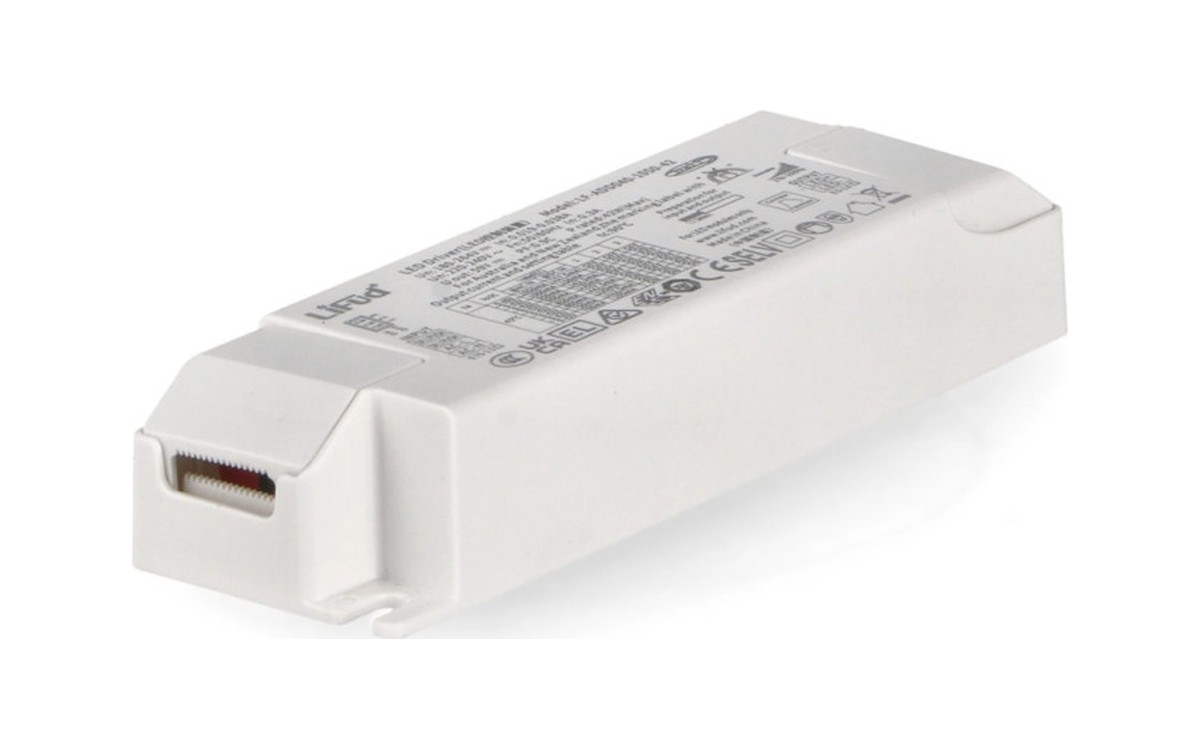
The chips of a panel, a high bay or a floodlight are fed with a fixed current in milliamps. The voltage adjusts itself within a range. The Lifud 0-10V 40W, for example, has an output of 25 to 42V DC and a current of 800 or 1050 mA. That is why the first thing to check on the label is the adjustable output current in mA that each model supports.
24V power supply for constant voltage LED strips
24V LED strips come with their resistors built in and only need a fixed voltage. The power supply gives a stabilized 24V DC output voltage whatever the load, and the strip takes what it consumes.
Philips Xitanium drivers for maximum reliability
Models available up to 150W
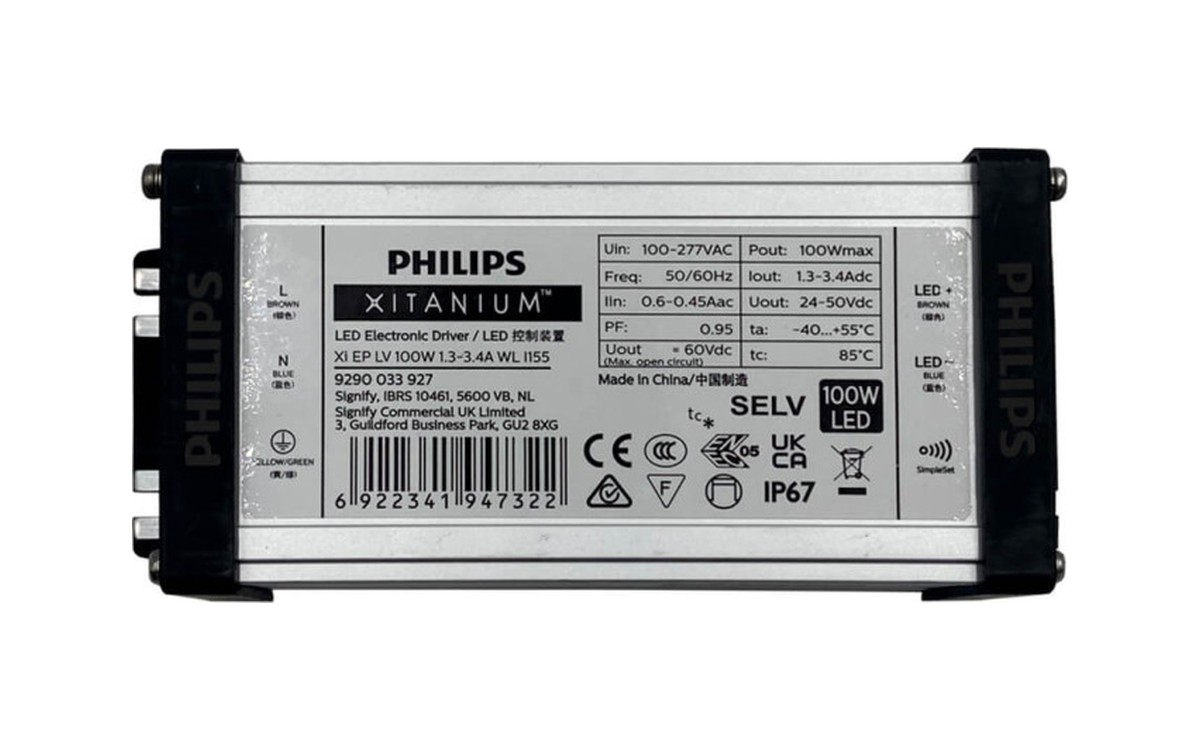
Ibérica's active catalog currently includes the 100W Xitanium, with 2100 mA and an input of 220 to 240V AC. Its power factor is 0.95, it has IP65 protection and carries CE, ENEC, CCC and RoHS marks.
A 150W high bay needs a Philips Xitanium 150W driver, or a more powerful one. That model is not currently in the online catalog, so it is worth confirming its availability. The price of a Philips Xitanium LED driver changes with the power and the current, and the current rate is on the page of each model.
Why the Philips driver guarantees 5 years in high bays and floodlights
The datasheet of the 100W Xitanium declares a 5 year warranty and an operating range of -40°C to +55°C with IP65 protection. It withstands a high bay in an unheated warehouse or a floodlight outdoors. For an LED driver for an industrial high bay, this data weighs more than the price.
Dimmable Lifud drivers for LED panels
The two Lifud drivers in the catalog are 40W, work with an input of 220 to 240V and have no output connector, so they are connected with terminal blocks.
Lifud 0-10V for analog dimming
The 0-10V dimmable LED driver varies the light with a low voltage signal, smoothly and precisely. Catalogs sometimes mix the DALI 1-10V analog protocol in the same line, and it is better to keep them apart: DALI is digital and 1-10V is analog.
Lifud DALI for advanced digital control
The Lifud DALI 40W panel driver allows each luminaire to be adjusted separately or in groups from a DALI controller. A dimmable Lifud DALI driver for an LED panel pays off in hotels, offices and public buildings with many luminaires.
Output current of 800 and 1050 mA available
Both Lifud drivers let you choose the current between 800 and 1050 mA. The Lifud 0-10V 800 1050 mA driver covers panels from different manufacturers with a single model. In refurbishments with a phase-cut wall dimmer there is also the dimmable TRIAC LED driver, which needs no additional control cable.
Gxtronic 24V power supplies for LED strips
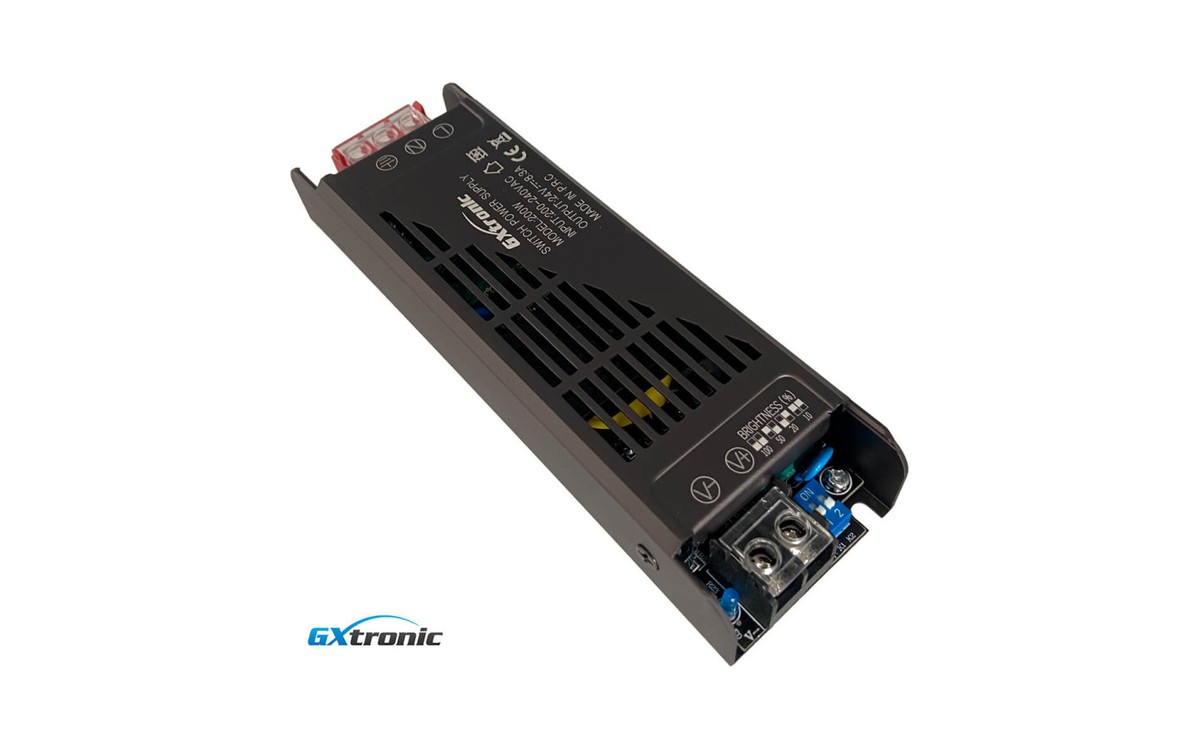
The Gxtronic range is sold in five power ratings. Anyone typing "24v power supply for led strips" is looking for a constant voltage supply chosen by power. All of them have an aluminium housing, and anyone comparing supplies with "aluminium housing thermal dissipation" is looking for the part that spreads the heat at full load.
Models from 60W to 400W in IP20 aluminium
The indoor IP20 range has models of 60W (2.5 A), 100W (4.1 A), 150W (6.25 A), 200W (8.3 A) and 400W (16.6 A). The 24V 60W IP20 aluminium supply suits small installations and the 24V 400W IP20 Gxtronic supply suits long runs. All are class A and carry a 3 year warranty, the answer for anyone typing "24v led power supply warranty".
The search "24v power supply gxtronic 120w" returns nothing, because the range goes from 100W to 150W. The catalog has a 120W one from the ECOLED brand, with a 5 year warranty and 50,000 hours of life. Among similar supplies it is worth comparing the capacitor life of 50000h, because capacitors are usually the part that wears out most.
How to calculate the power needed for your installation
Multiply the consumption per metre of the strip by the length and add a 20% margin. With a 14.4 W/m strip and 10 metres you get 144W, which with the margin is 172.8W, and the 200W supply is the right one. The AC DC conversion efficiency of the driver also counts, because a supply at its limit loses more energy as heat.
External driver vs integrated driver: when to use each
The search "external vs integrated driver difference" has a concrete answer. The integrated driver sits inside the luminaire and the external one is a separate part. The external vs integrated LED driver comparison is decided by whether the light needs dimming, whether the luminaire is in a hard-to-reach place and whether the manufacturer supplies spares.
Advantages of the external driver for easy replacement
If the driver fails, it is replaced without throwing away the luminaire. It also lets you choose the type of dimming and change it later.
When the integrated driver is enough
In a fixed, low power luminaire, without dimming and with easy access, the integrated driver is the simplest option, because the manufacturer has already matched it to the chip.
Driver compatibility with panels, high bays and strips
Luminaire power driver compatibility is resolved with three checks. The output voltage must cover that of the luminaire, the current must match what the manufacturer asks for and the driver power must be somewhat higher. In LED driver compatibility between panels and strips the rule changes with the load. LED panels and industrial high bays need constant current, and 24V LED strips need constant voltage.
The search "CE UL certification driver power supply" mixes two marks. UL is of American origin and in Europe the CE mark is mandatory. A professional driver must also declare its short circuit and overload protection.
Quick selection guide by luminaire type
| Luminaire | Recommended equipment | What to check |
|---|---|---|
| DALI dimmable LED panel | Lifud DALI 40W driver | Current 800 or 1050 mA |
| LED panel with analog dimming | Lifud 0-10V 40W driver | 0-10V control signal |
| High bay or floodlight | Philips Xitanium driver | Power and current |
| Indoor LED strip | Gxtronic 24V IP20 power supply | Power with 20% margin |
Panels go with the Lifud DALI LED drivers, high bays with the Philips Xitanium drivers of the same category and strips with the Gxtronic 24V power supplies.
Frequently asked questions about LED drivers and 24V power supplies
What is the difference between an LED driver and a 24V power supply?
The driver keeps the current constant and the power supply keeps the voltage constant. Panels, high bays and floodlights need a driver, and 24V strips need a power supply.
Which driver do I need for a 40W DALI dimmable LED panel?
A DALI one of at least 40W whose output covers the panel voltage and with the current the manufacturer indicates. The Lifud DALI 40W gives 9 to 42V DC and 800 or 1050 mA.
Is the Philips Xitanium driver compatible with all UFO LED high bays?
No, it depends on the power and current of each high bay. The 100W Xitanium delivers 2100 mA.
Can I replace the integrated driver of my luminaire with an external dimmable one?
Yes, if the luminaire can be opened and the new driver covers its voltage and its current. It is worth checking first that it does not affect its warranty.
What power of 24V supply do I need for 10 metres of LED strip?
It depends on the consumption per metre. With 14.4 W/m you need a 200W one and with 10 W/m a 150W one is enough, both with a 20% margin.
Do Lifud drivers have a warranty?
They are sold with a professional warranty, but the datasheets of the two Lifud drivers in the catalog do not state the term in years. It is worth confirming it with Ibérica before ordering.
What is the difference between 0-10V and DALI dimming in a driver?
0-10V is analog and varies the light with a control voltage. DALI is digital and allows each luminaire to be addressed or grouped from a controller.
Posted in:
Sample Category
Related posts
60x60 LED panels: everything you need to know before buying
Discover how to choose the ideal 60x60 LED panel for your project. We compare drivers, wattages, installation types...
Read more
A practical guide to choosing the perfect LED lighting for your office
Find out how to choose the perfect LED lighting for your office: it complies with the EN 12464 standard, boosts your...
Read more
Slim recessed LED downlights: guide to models, wattages and prices
Discover the differences between circular and square models, available wattages from 6W to 26W, key features such as...
Read more
LED colour temperature: how to choose between 2700K, 4000K and 6500K for your space
Warm, neutral or cool light: each LED colour temperature has its ideal space. We explain the differences between...
Read more
LED track spotlights for shops: single-phase vs three-phase, models and installation keys
Single phase or three-phase? Choosing the right LED track system makes the difference between a well-lit shop and one...
Read more
Search in blog
Blog categories
Latest posts
Three-phase track spotlights for shops and art galleries: Uppsala CRI 98 and Graz 3CCT for maximum visual impact
Read more
How to calculate the LED power needed per room: formula, lux tables and practical examples
Read more
Learn how to calculate LED power from lumens per square metre with a simple formula, a lux table by type of space and...
LED drivers and 24V power supplies: which one you need for each luminaire and how to choose without mistakes
Read more
Choosing well between an LED driver and a 24V power supply prevents flicker and failures. We review the differences,...
LED Lighting for Hotels: Common Areas and Rooms
Read more
Which fitting each hotel area needs: reception, corridors, rooms, spa and restaurant. We cover colour temperatures,...

E14 and G9 LED Bulbs: Replacements for Decorative Lamps
Read more
A guide to replacing the bulbs in your decorative lamps with LED and no building work. We explain which E14 candle or...
Popular posts
60x60 LED panels: everything you need to know before buying
Discover how to choose the ideal 60x60 LED panel for your project. We compare drivers, wattages, installation types...
Read more
LED colour temperature: how to choose between 2700K, 4000K and 6500K for your space
Warm, neutral or cool light: each LED colour temperature has its ideal space. We explain the differences between...
Read more
LED strips 220V AC: how to install them without a transformer and get the most out of them
220V AC LED strips plug straight into the mains without needing a transformer. In this guide we explain what models...
Read more

LED public lighting: current regulations, technical requirements and key points for compliance
Guide to Spain's LED public lighting regulations: technical requirements, road classes, parameters and mandatory...
Read more
A practical guide to choosing the perfect LED lighting for your office
Find out how to choose the perfect LED lighting for your office: it complies with the EN 12464 standard, boosts your...
Read more
Leave a comment