LED lighting and restaurant ambience decide how long your guests stay at the table. We explain which colour...
.svg)

LED sports lighting: technical guide for courts, tracks and sports halls
LED sports lighting is governed by a standard, not by each installer's own judgement. BS EN 12193 sets the lux, the uniformity and the glare according to the level of play.
Those three figures decide everything else, how many fixtures, what power and at what height. Adequate lighting avoids complaints from members. Here are the values by sport and the luminaires for each venue.
Lighting regulations for sports facilities
The BS EN 12193 standard for sports facilities is the reference in the UK and across Europe. It sets the minimum lighting requirements for each use. Anyone looking for sports lighting lux regulations will find the official values there.
BS EN 12193 illuminance levels
Horizontal and vertical illuminance levels are measured on the ground and on the player's plane. Horizontal illuminance is what matters in almost every sport. Vertical illuminance only counts when there are cameras.
The standard also sets the maintenance factor (fm), which accounts for light loss over the years. Without that factor, the pitch meets the requirement in year one and fails by year three.
Sports lighting classes I, II and III
The Class I, II and III sports classification ranks venues by audience and level of play.
Class III covers training and local recreational sport. Class II applies to matches with a local crowd. Class I is for full stands. Amateur-to-professional sport lux levels range between 200 and 750 lux on that scale.
What TV requires to broadcast matches
Everything changes with cameras. The lux required for TV broadcast cameras rises to 1000 lux or more, and demands close attention to the vertical light over the pitch.
LED lighting for TV broadcast also needs flicker-free fixtures, because slow-motion cameras pick it up. Low flicker and a stable driver are required.
Lux levels by type of sport
These are average reference values. Each case is confirmed with a lighting study.
| Sport | Class III | Class II | Class I |
|---|---|---|---|
| 11-a-side and 7-a-side football | 200 | 200 to 500 | 500 |
| Futsal | 200 | 300 | 500 |
| Basketball and handball | 200 | 300 | 500 |
| Padel and tennis | 300 | 500 | 750 |
| Athletics | 200 | 300 | 500 |
| Swimming pool | 200 | 300 | 500 |
Futsal and 7-a-side football
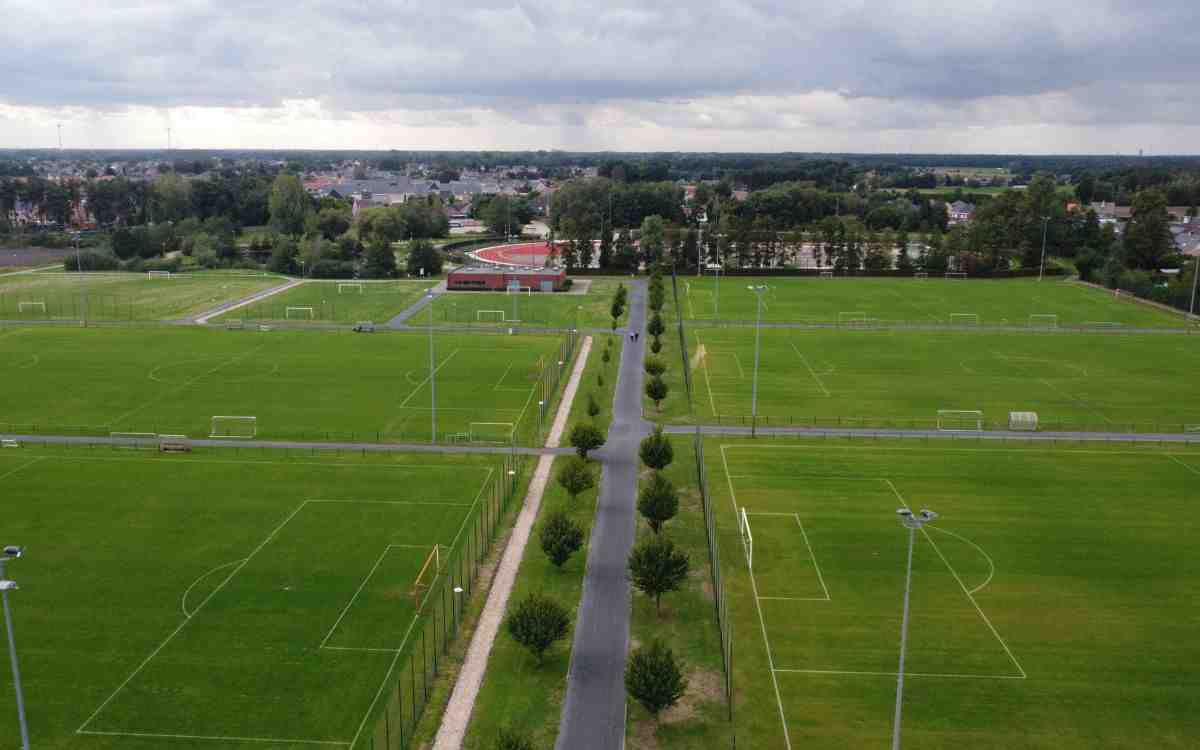
LED lighting for an indoor futsal court in a sports hall is solved with high bays or ceiling-mounted floodlights. Outdoors, an LED floodlight for a 7-a-side pitch goes on side poles. On an 11-a-side pitch, it moves up to corner towers.
Basketball and handball
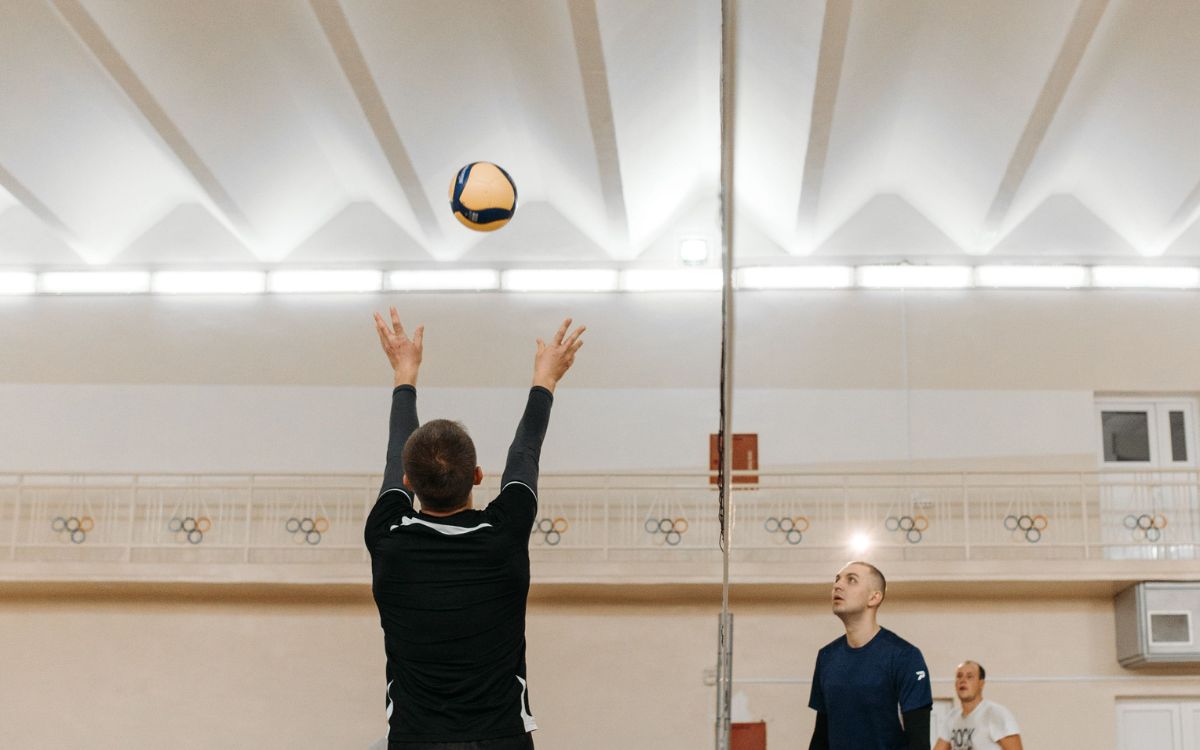
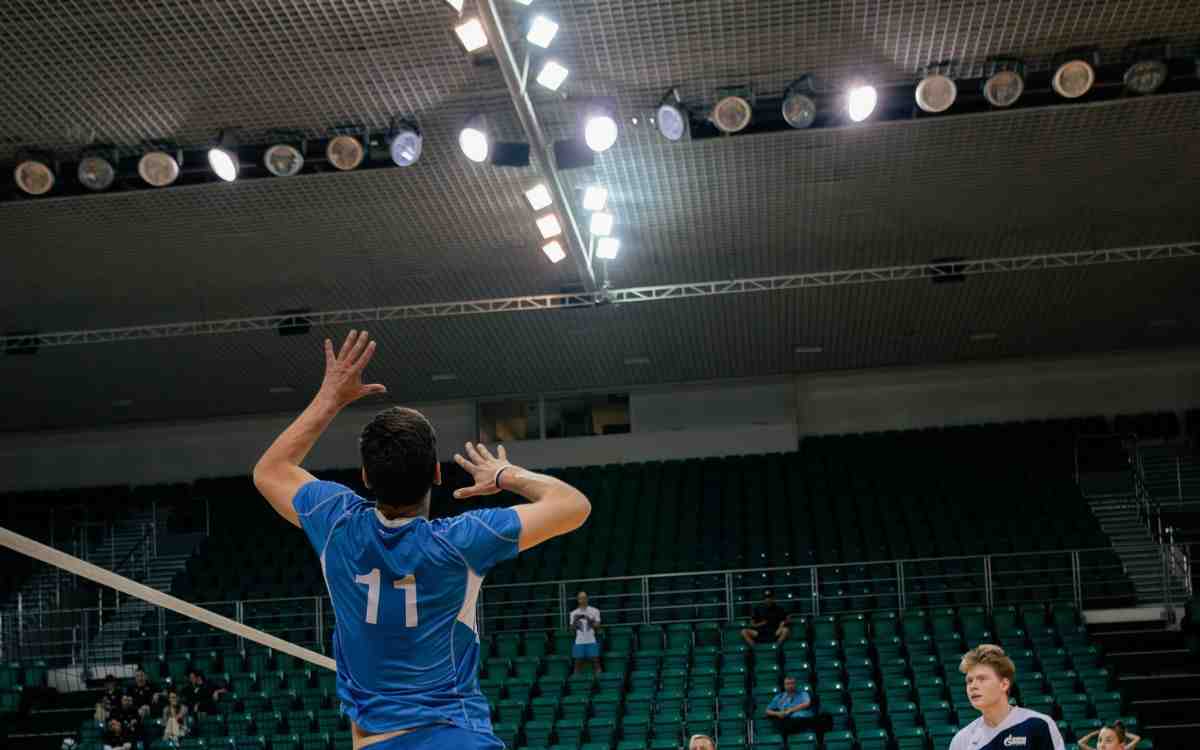
LED lighting for a basketball court calls for 300 lux for matches with spectators and good uniformity in the corners. Handball uses the same values. On an indoor court, the glare the player sees when looking up is what matters most.
Padel, tennis and athletics
LED lighting for a padel or tennis court needs 300 lux in Class III and no shadows on the glass. LED lighting for an athletics track is solved with tall poles along the straight. In both cases, the player's visual comfort matters as much as the quantity of light.
Indoor swimming pools and swimming
LED lighting for an indoor swimming pool has to deal with humidity and chlorine, so it calls for protected fixtures and fittings that won't rust. Reflection off the water means the light source has to stay clear of the swimming lane axis.
Which luminaires to use in each venue
Not every sports space needs the same fixtures. In LED sports lighting there are three families, and LED lights change shape depending on whether they're for indoor or outdoor use.
High-power LED floodlights for outdoor use
On outdoor pitches and tracks, 240W to 1200W floodlights rule. An IP65 outdoor sports LED floodlight withstands rain and dust. Sports luminaire mounting height sets the beam angle and the number of fixtures needed.
UFO LED high bays for indoor sports halls
A UFO LED high bay distributes light from 6 to 12 metres up. It's the most common choice for LED sports hall lighting. For large indoor courts, an indoor sports centre LED floodlight with a narrow optic also works well.
Weatherproof battens for changing rooms and damp areas
Changing rooms, showers and storerooms call for IP65 weatherproof battens. These are simple, inexpensive, high-performance LED luminaires that cut energy consumption.
How to calculate the number of luminaires for a court
The sports pitch light-point calculation starts from the floor area, the target lux and the clear height.
Theoretical example. A padel court measures 20 x 10 metres and requires 300 lux. With 200W, 30,000-lumen floodlights, that works out to 6 to 8 units, depending on the optics and the height.
That number is fine-tuned with a lighting study, which checks the minimum in each zone.
Uniformity and glare control in sport
Sports lighting uniformity compares the minimum value with the average. 0.5 is normal in Class III and 0.7 in Class I.
The GR glare rating factor for facilities measures glare. The standard requires a GR below 50 outdoors.
Glare control is achieved with narrow optics, visors and height. Lowering the power doesn't work, because then there isn't enough light.
How to manage an LED sports lighting project
An LED sports lighting project starts by measuring what's already there. The study, the tender specification and the installation follow.
LED lighting for municipal sports facilities usually goes through a public tender, so it's worth submitting signed calculations and product data sheets.
A well-designed lighting system reduces maintenance costs over ten years. Sports facility lighting is defended with measured lux and annual spend, not with brochures.
Frequently asked questions
How many lux does a padel court need according to the standard?
300 average lux in Class III, for club use without spectators. With spectators it rises to 500 lux, and to 750 at the top level.
What's the difference between Class I, II and III in sports lighting?
The audience and the level of play. Class III is for training and local use, Class II for matches with spectators, Class I for the top level. Each step up requires more lux and better uniformity.
Can I broadcast matches with my current lighting?
Only if it reaches 1000 lux and controls the vertical light. Most local pitches fall well short.
Which LED floodlight is best for lighting an outdoor 7-a-side pitch?
400W to 600W floodlights on 12 to 15-metre side poles. With a narrow optic, the width is covered without throwing light outside the pitch.
Are UFO LED high bays suitable for sports halls?
Yes, on ceilings from 6 to 12 metres. It's worth fitting them with a guard if there are balls in play. For higher ceilings, the floodlight wins out.
How much can I save by switching my sports centre's lighting to LED?
It depends on the old equipment and the hours of use. Switching from old lamps typically saves between 50% and 60% of consumption.
What colour temperature is best for sports facilities?
The usual colour temperature is 4000 K indoors and 5000 K outdoors. A 5000K or 4000K colour temperature for sport gives good contrast without tiring the eyes.
Posted in:
Sample Category
Related posts
60x60 LED panels: everything you need to know before buying
Discover how to choose the ideal 60x60 LED panel for your project. We compare drivers, wattages, installation types...
Read more
A practical guide to choosing the perfect LED lighting for your office
Find out how to choose the perfect LED lighting for your office: it complies with the EN 12464 standard, boosts your...
Read more
Slim recessed LED downlights: guide to models, wattages and prices
Discover the differences between circular and square models, available wattages from 6W to 26W, key features such as...
Read more
LED colour temperature: how to choose between 2700K, 4000K and 6500K for your space
Warm, neutral or cool light: each LED colour temperature has its ideal space. We explain the differences between...
Read more
LED track spotlights for shops: single-phase vs three-phase, models and installation keys
Single phase or three-phase? Choosing the right LED track system makes the difference between a well-lit shop and one...
Read more
Search in blog
Blog categories
Latest posts
LED Lighting for Restaurants: Create Ambience
Read more
GU10 LED Spotlights: High Efficiency for Shops
Read more
The high-efficiency GU10 LED spotlight improves the ambience and energy savings of any shop. Find out which beam...
LED emergency lighting and presence detectors: regulations, types and how to install them correctly
Read more
Guide to LED emergency lighting and presence detectors covering the zones required by the CTE, the minimum evacuation...
LED sports lighting: technical guide for courts, tracks and sports halls
Read more
Technical guide to LED sports lighting with the lux levels required by the BS EN 12193 standard by sport and class,...
High-power LED floodlights for stadiums and sports facilities: complete technical guide
Read more
Technical guide to high-power stadium LED floodlights for pitches, tracks and roadways. Power ratings, real-world...
Popular posts
60x60 LED panels: everything you need to know before buying
Discover how to choose the ideal 60x60 LED panel for your project. We compare drivers, wattages, installation types...
Read more
LED colour temperature: how to choose between 2700K, 4000K and 6500K for your space
Warm, neutral or cool light: each LED colour temperature has its ideal space. We explain the differences between...
Read more
A practical guide to choosing the perfect LED lighting for your office
Find out how to choose the perfect LED lighting for your office: it complies with the EN 12464 standard, boosts your...
Read more
LED public lighting: current regulations, technical requirements and key points for compliance
Guide to Spain's LED public lighting regulations: technical requirements, road classes, parameters and mandatory...
Read more
LED strips 220V AC: how to install them without a transformer and get the most out of them
220V AC LED strips plug straight into the mains without needing a transformer. In this guide we explain what models...
Read more
Leave a comment