LED lighting for supermarkets and large retail spaces is decided zone by zone: gondolas, fresh food, freezers,...


LED lighting for supermarkets and large retail spaces: a zone-by-zone guide with CRI, colour temperature and the best luminaire
LED lighting for supermarkets and large retail spaces is decided zone by zone, not with a single luminaire model for the whole store. A gondola aisle, a butcher counter, a freezer room, a checkout and a loading dock need different solutions. Colour temperature, CRI, protection and power all change.
This guide goes through each zone with the technical criteria an operations director or a maintenance manager uses when preparing a high-volume renovation. It includes the recommended luminaire and a savings calculation.
Why lighting is a sales tool in the supermarket
Shoppers decide in a few seconds and almost always by sight. Light changes how the product looks, how orderly the aisle feels and how long people stay inside. A badly lit store looks dirtier and less fresh, even when the goods are identical to the competition's. Using the same cold white tube in aisles, butcher and checkouts is the most common mistake in older stores.
Light and the perception of freshness in food
The colour of food depends on the light it receives. With a low CRI the reds of meat go dull, bread looks yellowish and fruit loses its shine. With the right light the opposite happens and the product looks freshly placed on the shelf.
Two parameters rule. One is colour temperature, which is adjusted by section. The other is the colour rendering index, which in fresh food starts from a minimum CRI 80 in fresh food areas.
Energy savings in large stores, the greatest potential
The lights of a store run between twelve and sixteen hours a day all year. That is why energy efficiency in large retail spaces almost always starts with lighting.
In many chain audits, lighting weighs around a third of the store's electricity use. The reduction in consumption of LED vs fluorescent is around half of the installed power. Maintenance adds to that, because a quality LED lasts for years without changing tubes or ballasts.
Gondola and product shelf zone
The aisles take up most of the sales floor, so most of the budget goes here. Light must reach every shelf level evenly and not dazzle people walking down the aisle. A well-chosen linear luminaire for supermarket gondolas solves both problems.
Continuous linear luminaire for uniformity along the whole length
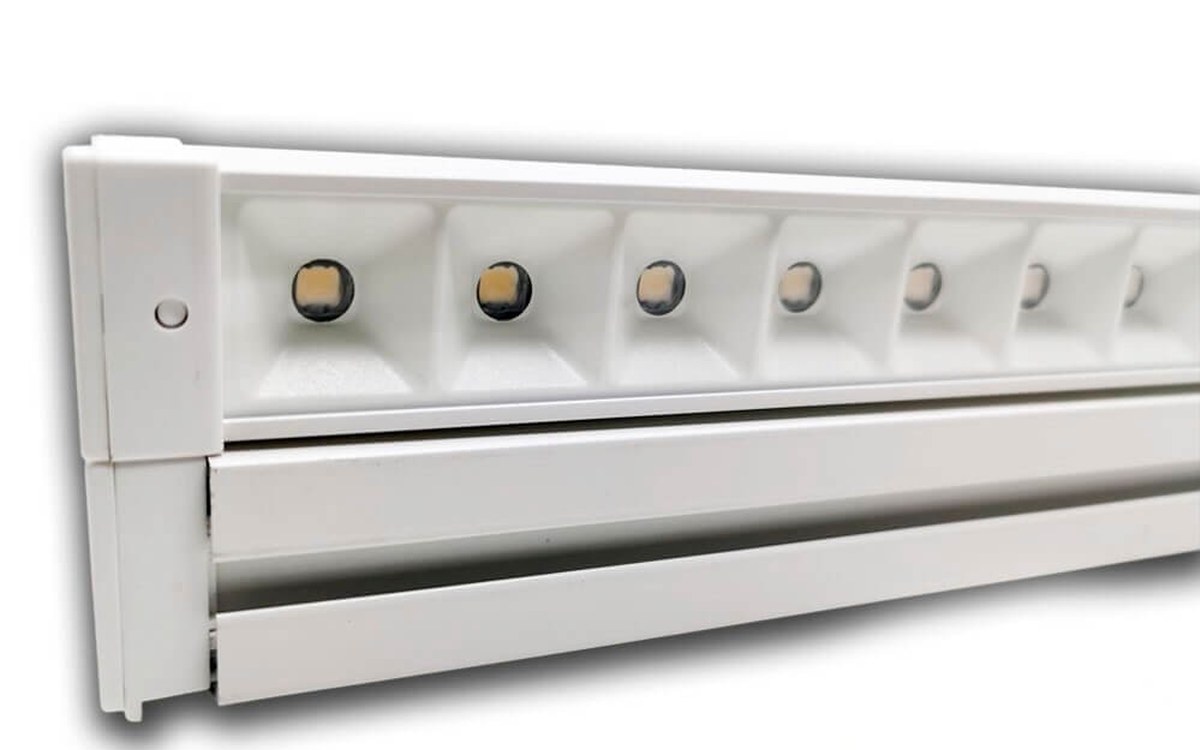
The linear LED luminaire for supermarket gondolas is mounted in a row over each aisle and the light runs from one end to the other without dark zones. A continuous linear LED luminaire for supermarkets avoids the bright spots of spotlights and the shadows between fixtures. For this zone, LED linear bars work well, because they chain together to cover the aisle and reduce connection points.
Buyers for a chain usually ask for the price of a linear LED batten for supermarkets per unit and per linear metre. It pays to compare both figures before choosing.
4000K temperature for a sense of cleanliness and order
In packaged goods, household and bazaar aisles, neutral light works well. A neutral 4000K colour temperature for fresh and dry goods conveys cleanliness without the bluish tone of 6000K, which cools the product and tires the eyes. At 4000K labels are easy to read and package colours look true.
Fresh food zone: butcher, fishmonger and deli
This is the zone where light weighs most on sales, because the shopper judges freshness at a glance. Here the choice is made for the colour of the product and not for consumption. The starting point is LED lighting for the butcher zone with high CRI.
Minimum CRI 80 for true colour rendering
A minimum CRI of 80 for LED lighting in fresh food is the floor and not the goal. Below it, reds look dull and fish loses its natural shine. At high-end meat and deli counters it is usually raised to 90. Check the figure on the manufacturer's data sheet, because some catalogues state the typical CRI and not the guaranteed minimum.
Pink filter in the butcher shop to improve the look of meat
The pink filter is a niche product with strong demand in butcher shops. It enhances the reddish tones of meat and cold cuts and gives a fresher look without touching the product. It is placed over the tube or over the luminaire, depending on the system. Try it on one counter before rolling it out across the whole chain, because a filter that is too strong makes the meat look artificial.
3000K temperature for warmth in fresh food
A warm 3000K light reinforces the red, orange and golden tones of meat, bread and cheese. A counter at 6000K makes ham and veal look greyish. The change between aisle and fresh zone should be gradual, so the shopper does not feel they are entering another store inside the same hall.
Freezer and refrigeration zone
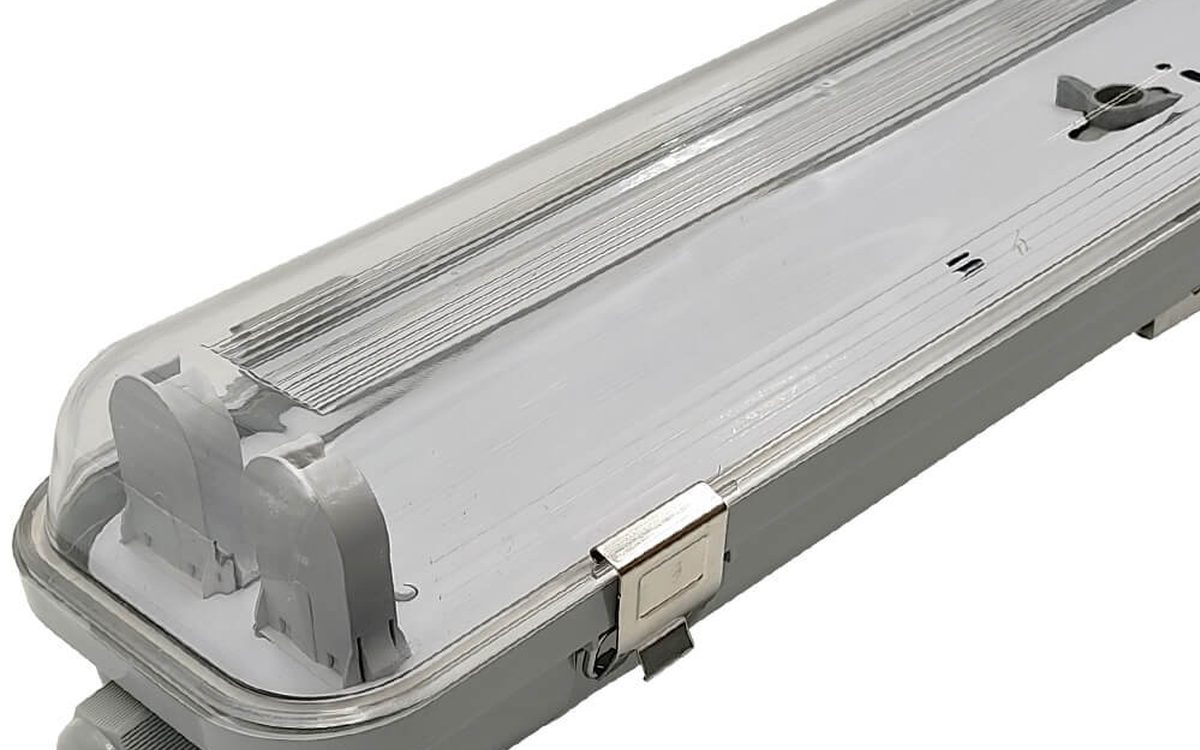
Freezer cabinets and cold rooms are the most demanding environment in the store. There is cold, humidity and doors that open hundreds of times a day. That is why a cold-resistant luminaire for the freezer zone is a purchase criterion and not an extra.
Luminaires resistant to negative temperatures
LED performs well in the cold and its efficiency improves slightly at low temperature. The weak point is the driver, the housing and the diffuser, which must withstand negative temperatures without cracking. When ordering LED lighting for the freezer zone, confirm the operating range the manufacturer declares. A luminaire designed for an office can fail within a few months inside a cold room.
Suitable IP rating for humidity in cold rooms
Condensation and washing with water call for a high protection rating. In cold rooms and freezers, IP65 is recommended as a minimum, with a closed diffuser and sealed gaskets. Food lighting regulations and good hygiene practice also require that luminaires above exposed food are protected against breakage. A closed diffuser meets both.
Checkout and customer service zone
At the checkouts staff work all day reading screens, codes and receipts. The priority moves from the display to the workstation and visual comfort rules. The UNE-EN 12464-1 standard places checkout workstations at around 500 lux.
UGR19 LED panels for workstations
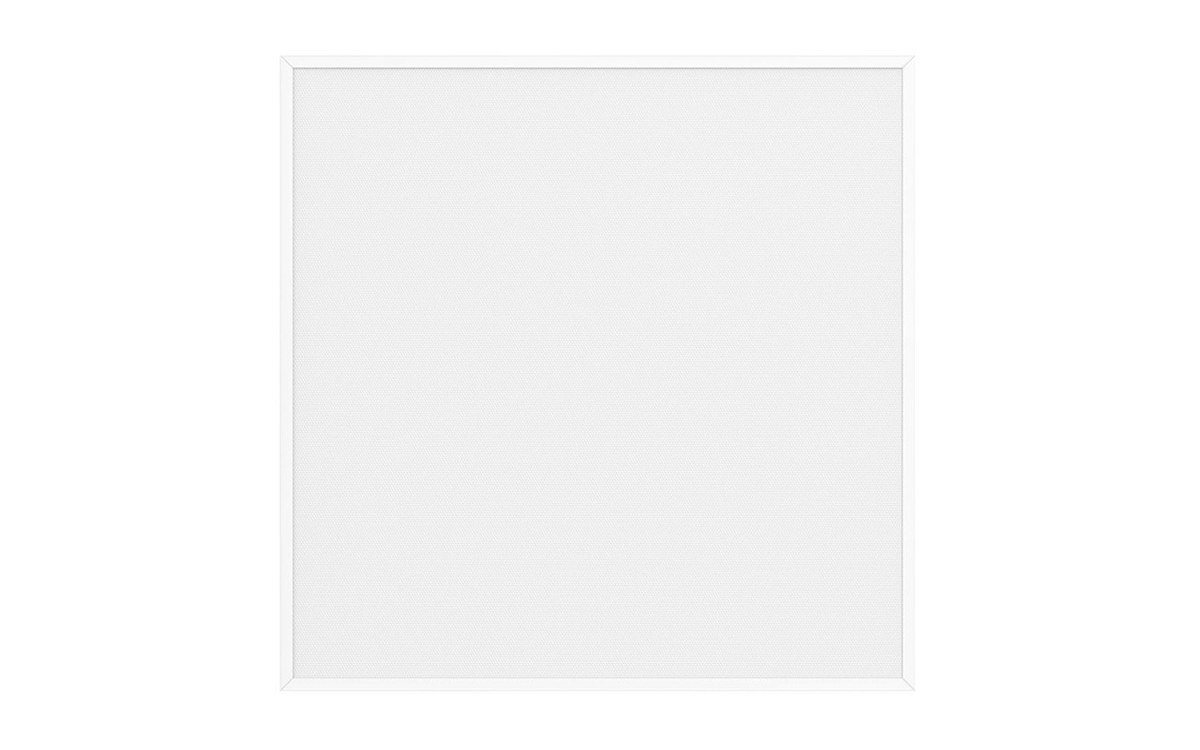
The LED panel with UGR for the checkout work zone is chosen with a maximum glare rating of 19, the usual value for reading and screen tasks. An LED panel for the checkout zone with a microprismatic diffuser spreads the light without annoying glare on the monitor. The LED panel category gathers the most used formats, and for any LED panel for supermarket checkouts it is useful to ask for the dimmable version too.
4000K temperature for concentration and performance
Neutral 4000K light keeps attention up without tiring the eyes during the shift. It is the same temperature as the aisles. That way the checkouts blend with the rest of the store and the shopper does not notice a change of atmosphere when paying.
Warehouse and loading and unloading zone
In the warehouse and on the dock, power, height and durability matter more than colour. The ceiling is usually six metres or more, dust is constant and maintenance at height is expensive. A well-chosen industrial LED high bay for the loading and unloading zone reduces trips up on a lift platform.
UFO LED high bays for great heights
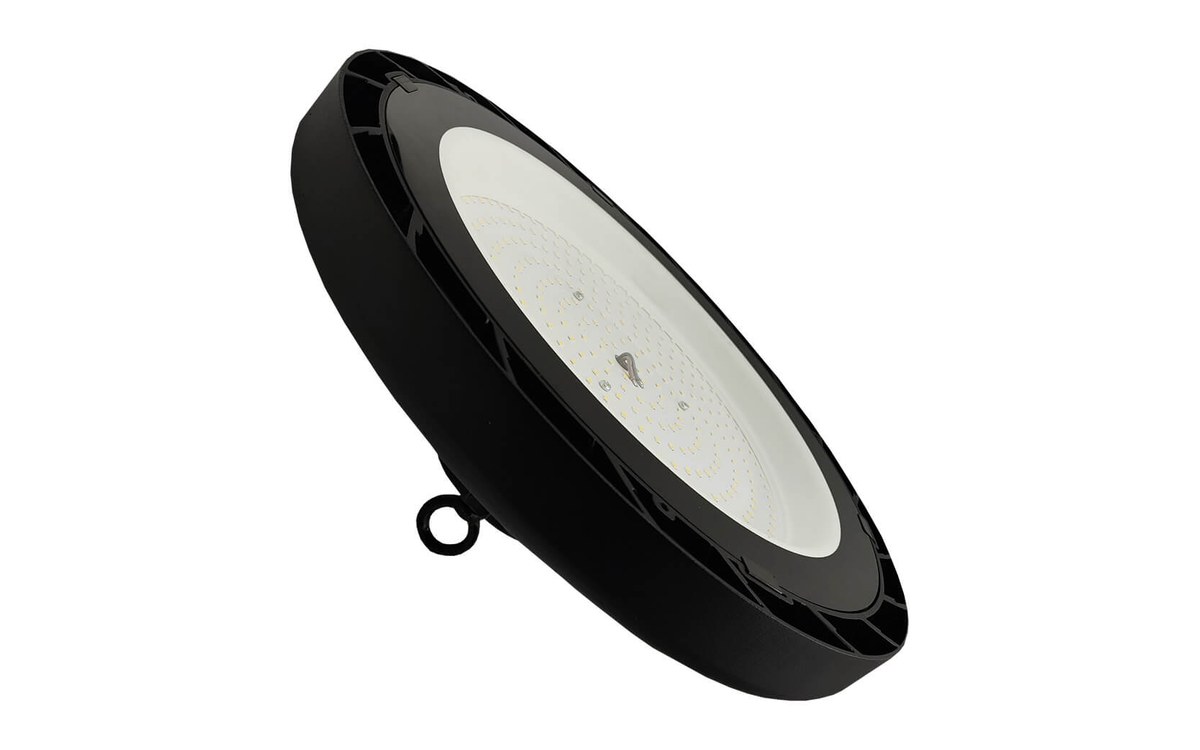
The UFO high bay for the loading and unloading zone is the usual luminaire for high ceilings, because it concentrates the flux downwards and covers large areas with few points. The UFO LED high bay for the supermarket warehouse is hung or anchored to the roof. The industrial UFO high bay category offers powers from 100W to 200W.
At six metres medium powers are enough. From eight metres up it pays to raise the power or narrow the beam angle so the light reaches the floor at the required level.
Minimum efficiency of 150 lm/W to cut the bill
In a zone with so many hours of use, efficiency is what you pay for every month. A 150 lm/W high bay needs a third less wattage than a 100 lm/W one to give the same lumens. That difference repeats in every luminaire of the project. The figure must refer to the complete luminaire and not only the chip, because the driver and the optics reduce efficiency.
Calculating the energy savings in a large store
Zero maintenance for an LED luminaire in a store does not fully exist, but it comes close: a quality LED needs no tube or starter changes for years. To calculate the savings, take a store with this data: 30 kW installed in fluorescent, 14 kW after switching to LED and 16 hours of operation a day. Count 365 days a year and a cost of €0.14 per kWh.
| Item | Fluorescent | LED | Difference |
|---|---|---|---|
| Installed power | 30 kW | 14 kW | 16 kW |
| Annual consumption | 175,200 kWh | 81,760 kWh | 93,440 kWh |
| Annual electricity cost | €24,528 | €11,446 | €13,082 |
The store saves about 13,082 euros a year on electricity alone, without counting tube replacement or labour. In a chain of 12 identical stores the saving reaches about 156,979 euros a year. That is why LED supermarket lighting efficiency is treated as an investment and not as an expense.
How to manage a lighting project for a supermarket
A large-store LED lighting project is organised in phases. First the store is measured and its current state is noted by zones. Then the required lux level is calculated and the luminaire for each zone is chosen. With that the quote is requested, and the price of LED supermarket lighting is compared by zone and by unit, not with a single total.
In chains it pays to start with a pilot store. It is installed, consumption is measured for a few months and the result is confirmed before extending the change. In a large hypermarket LED lighting project you also have to define night works and the delivery schedule, besides the handling of the removed lighting. The table at the end summarises the criteria for each zone.
If you manage a chain or a commercial large-store LED lighting project, the Ibérica de Iluminación team guides you on the luminaires and prices for each zone. Contact us and we will prepare the study with you.
| Zone | Temperature | CRI | Luminaire | IP |
|---|---|---|---|---|
| Gondolas and shelves | 4000K | 80 or more | Continuous linear | IP20 |
| Fresh food | 3000K | 80 minimum and 90 for meat | Linear with pink filter | IP44 or IP65 |
| Freezers | 4000K | 80 or more | Waterproof for cold | IP65 |
| Checkouts | 4000K | 80 or more | UGR19 LED panel | IP20 |
| Warehouse and loading | 4000K to 5000K | 70 or more | UFO LED high bay | IP65 |
Frequently asked questions about LED lighting in supermarkets
What minimum CRI does the lighting of a butcher or fishmonger need?
The reasonable minimum is CRI 80, and for high-end meat and fish it is recommended to go up to 90. With a low CRI the reds look dull and the product loses appeal on the counter.
Which LED luminaire is best for lighting supermarket gondolas?
The continuous linear luminaire, mounted in a row over each aisle, because it spreads the light evenly and without shadows between shelves. It works well at 4000K.
Which LED panel should I use for the checkout zone?
An LED panel with UGR19, a microprismatic diffuser and 4000K. It reduces reflections on screens and keeps visual comfort throughout the shift.
Do LED luminaires withstand the negative temperatures of the freezer zone?
Yes, as long as they are rated for that range. LED performs well in the cold, but the driver and the housing must be prepared, and IP65 is recommended as a minimum.
How much electricity does a supermarket save by switching to LED?
Installed power usually drops by half compared to fluorescent. In the calculation in this article, a store saves about 13,082 euros a year on electricity alone.
Can the pink filter be installed on any LED T8 tube?
Not always. The filter must match the tube in length and diameter, and it pays to test it first on one counter. If the tube has its own diffuser or ventilation, its compatibility is checked.
Do you offer turnkey projects for supermarket chains?
Yes. We study the store zone by zone and propose luminaires and a quote. You can start with a pilot store before extending the project to the whole chain.
Posted in:
Sample Category
Related posts
60x60 LED panels: everything you need to know before buying
Discover how to choose the ideal 60x60 LED panel for your project. We compare drivers, wattages, installation types...
Read more
A practical guide to choosing the perfect LED lighting for your office
Find out how to choose the perfect LED lighting for your office: it complies with the EN 12464 standard, boosts your...
Read more
Slim recessed LED downlights: guide to models, wattages and prices
Discover the differences between circular and square models, available wattages from 6W to 26W, key features such as...
Read more
LED colour temperature: how to choose between 2700K, 4000K and 6500K for your space
Warm, neutral or cool light: each LED colour temperature has its ideal space. We explain the differences between...
Read more
LED track spotlights for shops: single-phase vs three-phase, models and installation keys
Single phase or three-phase? Choosing the right LED track system makes the difference between a well-lit shop and one...
Read more
Search in blog
Blog categories
Latest posts
LED lighting for supermarkets and large retail spaces: a zone-by-zone guide with CRI, colour temperature and the best luminaire
Read more
Linear LED luminaires: Nápoles DALI battens and Artistic Osram for supermarkets, offices and logistics
Read more
A continuous DALI linear LED luminaire gives light with no joins in supermarkets, offices and warehouses. Compare the...
Single-phase vs three-phase LED track: key differences, maximum load and when to use each system
Read more
The differences between single-phase and three-phase LED track lie in the number of circuits, the load each one...
Three-phase track spotlights for shops and art galleries: Uppsala CRI 98 and Graz 3CCT for maximum visual impact
Read more
Learn how to choose a three-phase track spotlight for a shop or art gallery with the Uppsala CRI 98 and the Graz...
How to calculate the LED power needed per room: formula, lux tables and practical examples
Read more
Learn how to calculate LED power from lumens per square metre with a simple formula, a lux table by type of space and...
Popular posts
60x60 LED panels: everything you need to know before buying
Discover how to choose the ideal 60x60 LED panel for your project. We compare drivers, wattages, installation types...
Read more
LED colour temperature: how to choose between 2700K, 4000K and 6500K for your space
Warm, neutral or cool light: each LED colour temperature has its ideal space. We explain the differences between...
Read more
LED strips 220V AC: how to install them without a transformer and get the most out of them
220V AC LED strips plug straight into the mains without needing a transformer. In this guide we explain what models...
Read more
LED public lighting: current regulations, technical requirements and key points for compliance
Guide to Spain's LED public lighting regulations: technical requirements, road classes, parameters and mandatory...
Read more
A practical guide to choosing the perfect LED lighting for your office
Find out how to choose the perfect LED lighting for your office: it complies with the EN 12464 standard, boosts your...
Read more
Leave a comment