LED lighting and restaurant ambience decide how long your guests stay at the table. We explain which colour...
.svg)

LED emergency lighting and presence detectors: regulations, types and how to install them correctly
LED emergency lighting and presence detectors solve two different problems within the same building. One part complies with the law and the other cuts the bill.
Emergency lighting is required by law and checked at inspection. No standard requires a motion detector, but it turns the light off when nobody's there. In residential blocks and car parks they're fitted together, because the electrician is already on site.
LED emergency lighting required by law in buildings
Emergency lighting comes into play when the mains power fails. It must switch on by itself, last one hour and mark the exit without relying on the grid.
What the BS EN 60598 standard and the CTE say
The BS EN 60598 emergency standard defines the equipment. The CTE says where it's needed and with how much light.
Building emergency lighting regulations require it to switch on in under five seconds and to run for one hour. An emergency LED luminaire compliant with the standard carries a CE mark, its own battery and a switch-on test.
Where emergency lights need to be installed
The CTE marks the zones by use and floor area. These are the most common cases.
| Zone | Minimum lux |
|---|---|
| Escape routes | 1 |
| Stairs and corridors | 1 |
| Car parks over 100 m2 | 1 |
| Public toilets | 1 |
| Electrical panels | 5 |
| Firefighting equipment | 5 |
Supplementary evacuation signage is the exit signs. They accompany the lighting and don't replace it.
Minimum lux on escape routes
The minimum lux on escape routes is 1 lux on the floor of the passage and 5 lux in front of electrical panels and firefighting equipment.
On escape routes the measurement is taken along the centre line of the corridor. Long escape routes require several units, because a single one leaves dark areas.
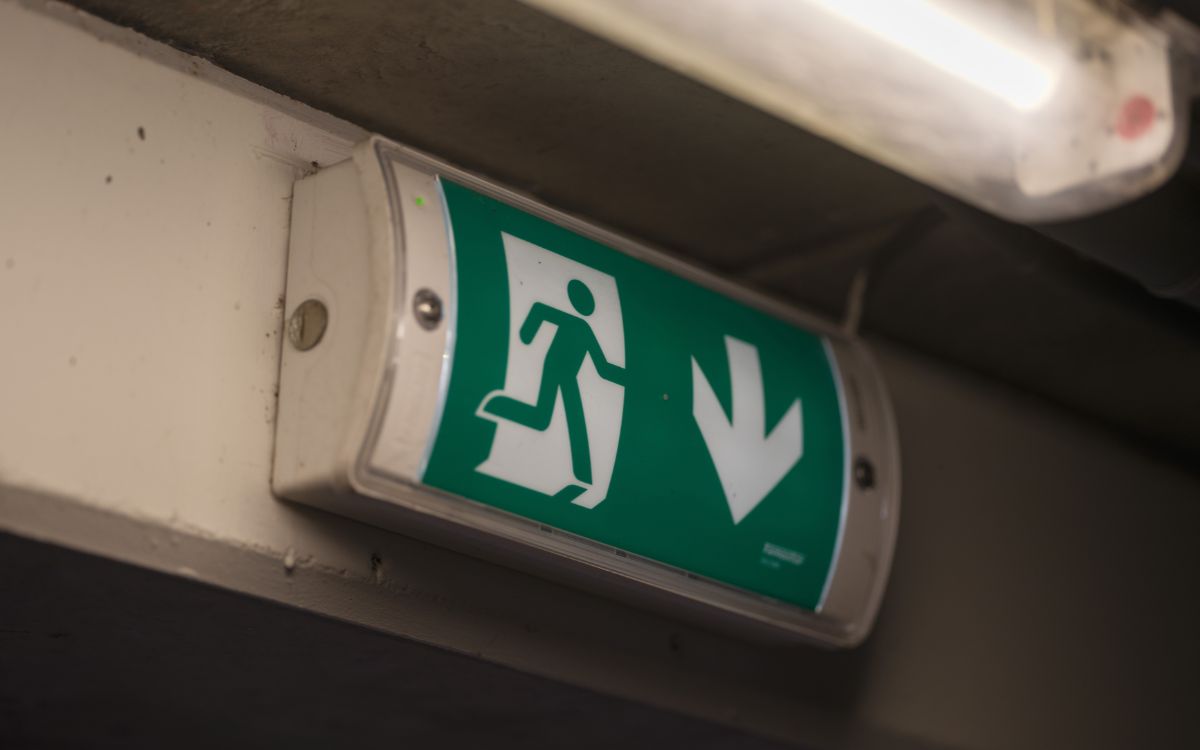
Types of LED emergency luminaire
All of them have a battery, LED and charging circuit. What changes is when they switch on and how they're checked.
Non-maintained emergency lighting, mains-failure only
This is the best-selling model. It stays off and switches on by itself when the power drops. A 400-lumen emergency LED unit of this type covers a standard landing and is the entry-level option when looking for an affordably priced LED emergency light.
Maintained emergency lighting, continuously on
The maintained type is always on and keeps lighting from its battery if the mains fails. It's used in cinemas, halls and venues with the public present.
The difference between maintained and non-maintained LED emergency lighting lies in daily consumption and the LED's service life.
Self-test models that check themselves
A self-test emergency LED unit tests itself every week and signals with an indicator light if the battery fails.
The automatic self-test function saves walking the building with a test pole. In large buildings, it's what brings down the cost of the annual inspection.
External battery for existing LED luminaires
An emergency battery for an LED luminaire turns an already-installed panel into emergency equipment. The kit is connected between the driver and the luminaire and acts as a power source if the mains fails.
The usual emergency battery backup time is one hour. An IP20 emergency LED ceiling kit is suited to dry indoor spaces. For an open car park or outdoors, an IP65 outdoor LED emergency light is required.
Presence detectors for energy savings
The sensor is fitted wherever the light stays on for no reason. The energy savings arrive on their own, without changing habits. Sensor-controlled lighting systems switch on as someone passes and switch off once the programmed time runs out.
PIR infrared detector for passageways
The passive infrared PIR detector senses movement from body heat. It works well in corridors, landings and toilets.
The sensor's detection angle and coverage is 180 or 360 degrees depending on the mounting. It needs to see the person, so a column will leave shadows.
Microwave radar sensor for areas with vehicles
The microwave radar motion sensor works with high-frequency waves and passes through glass or a thin panel. It's the usual choice in car parks, because it needs to detect a car entering slowly.
An LED presence detector with a radar sensor is more sensitive than the PIR. A 300W LED radar sensor controls several luminaires at once.
Slim surface-mounted detectors for quick installation
A slim surface-mounted motion detector is screwed to the ceiling with no building work. It's the quick solution when there's no recess available.
The presence detector's coverage area depends on the mounting height, so it's worth checking the diagram on the data sheet.
Combined uses of LED emergency lighting and presence detectors
In practice, the two products end up in the same order.
Residential stairwells and corridors
A presence sensor on a shared stairwell switches off the light when nobody's passing, and the emergency light covers the mains failure. Recessed or surface-mounted emergency installation is chosen depending on the ceiling of each landing.
Garages and car parks
The car park calls for radar, because the PIR doesn't read a slow-moving car well and the cold throws it off. Emergency lighting is required above 100 square metres.
Here the emergency light is placed on ramps, at exits and next to the panel.
Offices and industrial passageways
An LED presence detector for offices switches off empty meeting rooms and toilets. In warehouse aisles, the motion sensor is combined with 10% background light, so the area is never left completely dark.
How to install an emergency light step by step
First the height is marked, above the door or around 2 metres from the floor.
Then it's connected to that zone's lighting circuit, with live, neutral and earth. The battery charges on its own as soon as there's power.
The unit is tested by tripping the RCD. That's the only way to check if it switches on.
Catalogue photos are for reference, it's worth telling the customer about sizes, colours or textures before ordering. Check the data sheet so the product works correctly with the rest of the line.
Annual inspection and equipment care
The annual inspection is required by law and is recorded in writing. The duration of light, the switch-on and the battery condition are checked.
A device used daily, such as the car park detector, is cleaned once a year. A high-quality unit withstands more cycles, but no battery lasts forever. Replacement is due between four and five years.
Frequently asked questions about LED emergency lighting and presence detectors
Where is it mandatory to install emergency lights?
On escape routes, stairs and shared corridors. Also in car parks over 100 square metres and in public toilets. And next to electrical panels and firefighting equipment.
What's the difference between maintained and non-maintained emergency lighting?
Maintained lighting is always on. Non-maintained lighting only switches on if the mains fails. The first type is used in venues with the public present.
What is self-test in an emergency luminaire?
A test the unit performs on itself every week or every month. An indicator light signals if the battery or LED fails, without anyone having to check it in person.
Can I add an emergency battery to my existing LED luminaires?
Yes, with a kit compatible with the unit's power. It's fitted between the driver and the luminaire and provides one hour of light.
What's the difference between a PIR detector and a radar sensor?
In PIR vs radar differences, the PIR reads body heat and needs a clear view of the area. Radar passes through thin materials and picks up slow movements, such as a car.
How many lux does an escape route need?
1 lux on the floor of the route. In front of electrical panels and firefighting equipment, 5 lux is required.
How often do emergency lights need to be inspected?
At least once a year, with a written record. With self-test, the check is continuous and only needs to be logged.
Posted in:
Sample Category
Related posts
60x60 LED panels: everything you need to know before buying
Discover how to choose the ideal 60x60 LED panel for your project. We compare drivers, wattages, installation types...
Read more
A practical guide to choosing the perfect LED lighting for your office
Find out how to choose the perfect LED lighting for your office: it complies with the EN 12464 standard, boosts your...
Read more
Slim recessed LED downlights: guide to models, wattages and prices
Discover the differences between circular and square models, available wattages from 6W to 26W, key features such as...
Read more
LED colour temperature: how to choose between 2700K, 4000K and 6500K for your space
Warm, neutral or cool light: each LED colour temperature has its ideal space. We explain the differences between...
Read more
LED track spotlights for shops: single-phase vs three-phase, models and installation keys
Single phase or three-phase? Choosing the right LED track system makes the difference between a well-lit shop and one...
Read more
Search in blog
Blog categories
Latest posts

LED Lighting for Restaurants: Create Ambience
Read more

GU10 LED Spotlights: High Efficiency for Shops
Read more
The high-efficiency GU10 LED spotlight improves the ambience and energy savings of any shop. Find out which beam...
LED emergency lighting and presence detectors: regulations, types and how to install them correctly
Read more
Guide to LED emergency lighting and presence detectors covering the zones required by the CTE, the minimum evacuation...
LED sports lighting: technical guide for courts, tracks and sports halls
Read more
Technical guide to LED sports lighting with the lux levels required by the BS EN 12193 standard by sport and class,...
High-power LED floodlights for stadiums and sports facilities: complete technical guide
Read more
Technical guide to high-power stadium LED floodlights for pitches, tracks and roadways. Power ratings, real-world...
Popular posts
60x60 LED panels: everything you need to know before buying
Discover how to choose the ideal 60x60 LED panel for your project. We compare drivers, wattages, installation types...
Read more
LED colour temperature: how to choose between 2700K, 4000K and 6500K for your space
Warm, neutral or cool light: each LED colour temperature has its ideal space. We explain the differences between...
Read more

A practical guide to choosing the perfect LED lighting for your office
Find out how to choose the perfect LED lighting for your office: it complies with the EN 12464 standard, boosts your...
Read more
LED public lighting: current regulations, technical requirements and key points for compliance
Guide to Spain's LED public lighting regulations: technical requirements, road classes, parameters and mandatory...
Read more
LED strips 220V AC: how to install them without a transformer and get the most out of them
220V AC LED strips plug straight into the mains without needing a transformer. In this guide we explain what models...
Read more
Leave a comment