LED lighting and restaurant ambience decide how long your guests stay at the table. We explain which colour...
.svg)

High-power LED floodlights for stadiums and sports facilities: complete technical guide
A high-power stadium LED floodlight project is defended with numbers, not impressions. Whoever signs off the investment wants to know how many lux reach the pitch, how much the bill drops and how many years the equipment lasts.
Here are the figures that council tender specifications and sports facility technicians ask for. They apply just as well to a neighbourhood pitch as to a track with TV cameras.
What defines high-power stadium LED floodlights
These LED luminaires aren't simply large floodlights. The chip, the driver and the optics all change. A high-quality unit is recognised by its real luminous efficiency, its driver and its housing.
Power ratings from 240W to 1200W
The usual range runs from 240W to 1200W per unit. A 1000W or 1200W stadium LED floodlight is reserved for tall towers and full-size pitches.
For small tracks, a 480W or 240W matrix LED floodlight is enough. A 1200W SMD5050 LED floodlight concentrates a lot of luminous intensity in a single point and reduces the number of units needed.
Efficiency above 200 lm/W with Bridgelux chip
A high-brightness outdoor Bridgelux LED floodlight exceeds 200 lm/W, and the top-end models reach 240.
High luminous efficiency in lm/W is where the project's energy savings come from, because every watt saved is multiplied by the hours the lights are on. A 240 lm/W stadium LED floodlight delivers the same output as a 150 lm/W unit with around 37% less consumption.
Philips Xitanium driver for maximum reliability
The driver is the component that fails most often outdoors. A stadium LED floodlight with a Philips Xitanium driver fits circuits with protection against voltage spikes and temperature control.
The programmable Philips Xitanium driver allows the output power to be adjusted at the factory or on site. That reliability underpins the warranty on a 20-metre tower, where every replacement requires a crane.
Main uses
The same family covers different uses. The optics change, not the unit. LED lights replace old floodlights on poles that already exist.
Lighting for stadiums and football pitches
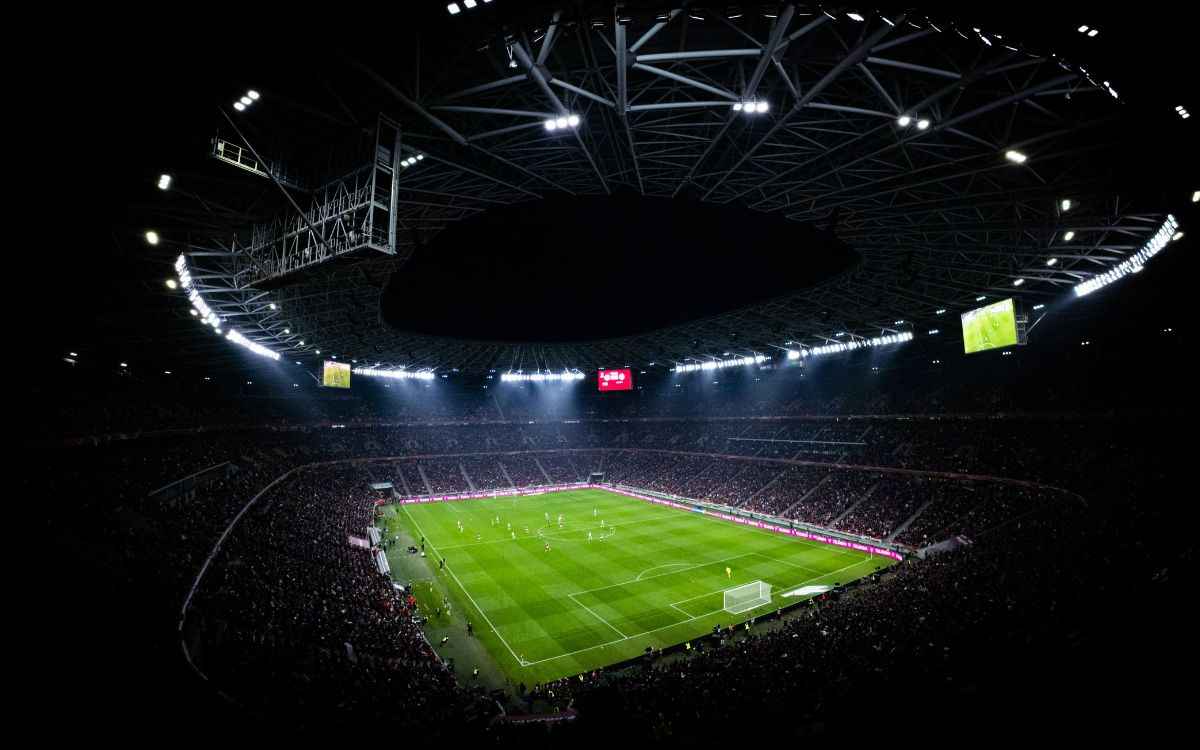
LED football pitch lighting calls for even distribution and glare control towards the goalkeeper and the stands. With high-power floodlights, the number of units per tower comes down.
Athletics tracks and outdoor venues
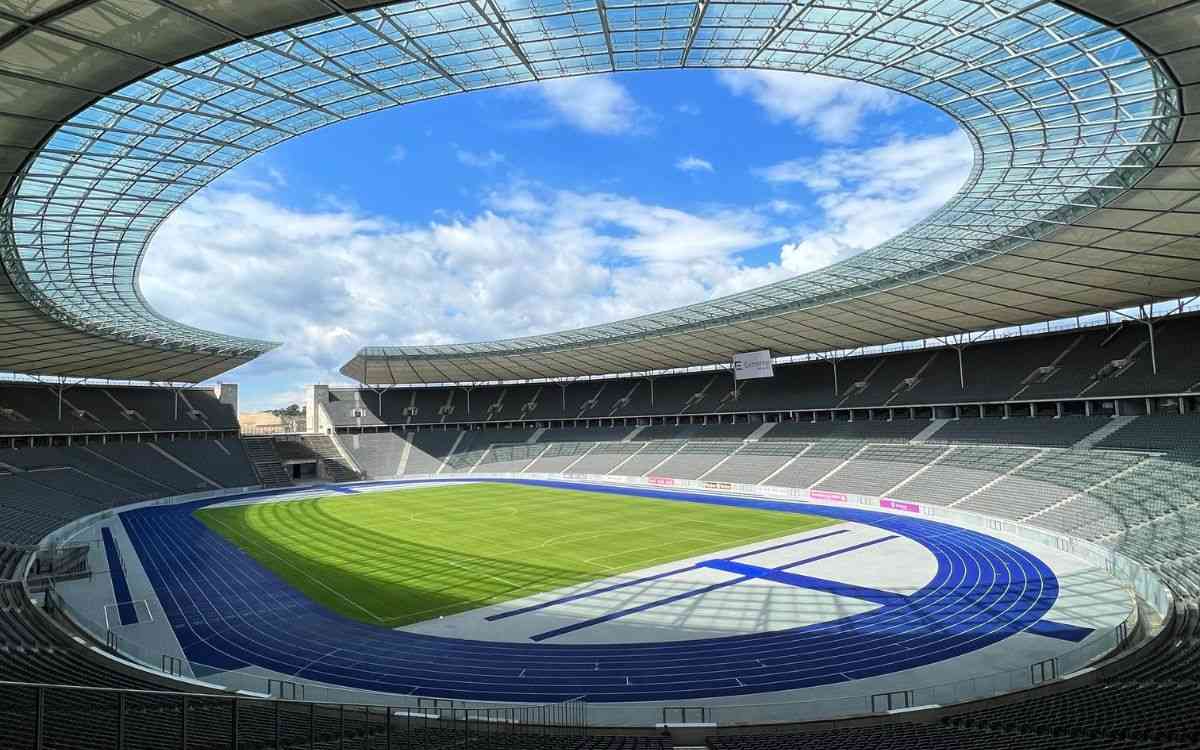
An LED floodlight for athletics tracks works with wide optics, because the surface is elongated. On outdoor tracks, uniform lighting is what matters most. Here, light distribution counts for more than the total installed power.
Large-scale road lighting and industrial estates
Outside sport, a high-power LED floodlight for road lighting covers roundabouts and loading areas. High-power outdoor LED lighting on industrial estates reduces the number of poles and light points. An IP65 high-power LED floodlight holds up well on roads, although on the coast it's worth going up a protection grade.
How to calculate the lighting for a sports pitch
The calculation is based on the EN 12193 standard and the level of play. The values in the table are for reference and are confirmed with a lighting study.
| Type of use | Average lux | Minimum uniformity |
|---|---|---|
| Training and free use | 200 | 0.5 |
| Local matches without spectators | 200 to 300 | 0.5 |
| Matches with spectators | 500 | 0.6 |
| National league | 750 | 0.7 |
| Matches with TV cameras | 1000 to 1500 | 0.7 |
Lux by level of play
Each step up the table multiplies the investment. A village pitch that will never have TV cameras doesn't need 1000 lux.
Matching lighting requirements to actual use is the decision that saves the most money in a tender.
Number of floodlights and pole height
Sports installation pole height and mounting determine the distribution. As a reference, the pole height exceeds a third of the distance to the furthest point. Sports lighting point calculations are done with calculation software, never by eye.
Theoretical example: a 100 x 64 metre pitch with four 20-metre towers requires 16 to 24 1000W floodlights.
Key technical data
IP66 for installations in extreme weather
Protection ratings are read as two figures, dust and water. IP66 certification for extreme weather withstands pressurised water jets and seals the unit.
The die-cast aluminium housing dissipates heat and slows down corrosion. In outdoor lighting, the enemy is moisture. With those two elements in place, a 100,000-hour outdoor service life becomes credible.
Programmable flux reduction during night-time hours
Night-time flux reduction lowers the power when the venue is empty. A matrix LED floodlight with a programmable driver supports stepped settings by time band.
Energy efficiency improves without touching the lux level during matches.
Beam angle and glare control
The beam angle decides where the light falls. A narrow, concentrated beam angle is suited to tall towers and long throws. A wide-angle stadium LED floodlight covers nearby surfaces with fewer units.
A 5000K colour temperature is the usual reference for sports lighting, because it improves contrast on camera and respects the colour of the light source.
Models in the catalogue's Stadium Matrix series
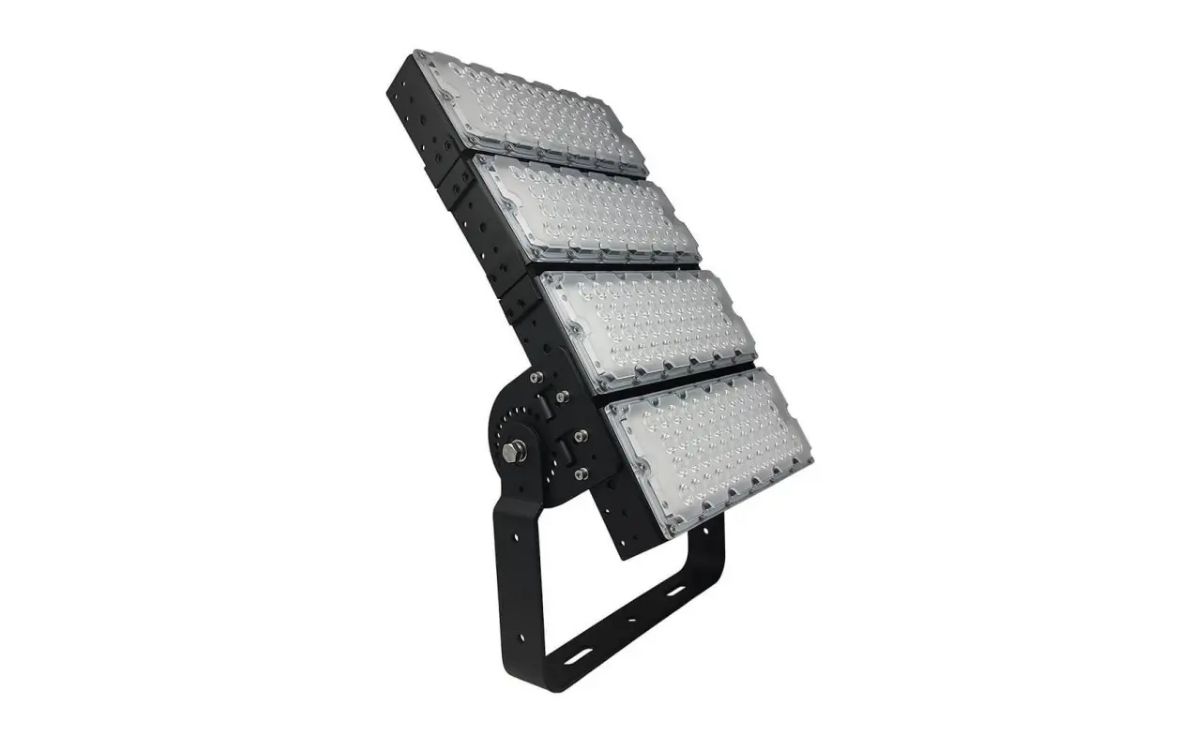
The Stadium Matrix series covers 240W to 1200W with a modular housing. The modules are aimed individually, so the distribution is fine-tuned on site.
All models provide lighting designed for outdoor use, with a programmable driver and interchangeable optics. Stadium LED floodlight pricing changes depending on power, optics and order volume, so it's worth requesting a fixed quote.
How to manage a large-scale sports lighting project
A sports lighting project starts by measuring the current state and ends by checking the lux levels achieved. In between come the lighting study, the tender specification and the installation.
For a high-power LED floodlight in a sports installation, request the optics' IES file before deciding. Lighting projects funded with public money require consumption and costs to be justified over ten years.
The lighting solution is defended with two figures, the average lux achieved and the annual lighting spend.
Frequently asked questions about high-power stadium LED floodlights
How many lux does a professional football pitch need?
Between 500 and 750 average lux for a national league without cameras. With TV cameras, it rises to 1000 or 1500 lux and a more even distribution is required.
What's the difference between a 240W and a 1200W LED floodlight?
The output and the reach. The 240W unit covers small tracks from 8 or 10 metres. The 1200W unit goes on tall towers and covers full-size pitches.
Does the Philips Xitanium driver improve the floodlight's service life?
Yes. It runs at a lower temperature, protects against voltage spikes and can be programmed. The driver is the most common cause of failure outdoors.
What IP rating does an LED floodlight need for outdoor stadium use?
IP65 is the minimum. IP66 is the better option on towers exposed to rain and pressure washing.
Can I reduce the floodlights' output during the early hours?
Yes, with a programmable driver. Time bands and reduction percentages are set, or it's controlled from an external control unit.
How many floodlights do I need to light an 11-a-side football pitch?
It depends on the target lux and the tower height. As a theoretical example, 16 to 24 1000W units on four 20-metre towers.
Do high-power floodlights generate a lot of heat?
They generate heat, but the aluminium housing dissipates it by convection. Without open air around them, service life drops.
Posted in:
Sample Category
Related posts
60x60 LED panels: everything you need to know before buying
Discover how to choose the ideal 60x60 LED panel for your project. We compare drivers, wattages, installation types...
Read more
A practical guide to choosing the perfect LED lighting for your office
Find out how to choose the perfect LED lighting for your office: it complies with the EN 12464 standard, boosts your...
Read more
Slim recessed LED downlights: guide to models, wattages and prices
Discover the differences between circular and square models, available wattages from 6W to 26W, key features such as...
Read more
LED colour temperature: how to choose between 2700K, 4000K and 6500K for your space
Warm, neutral or cool light: each LED colour temperature has its ideal space. We explain the differences between...
Read more
LED track spotlights for shops: single-phase vs three-phase, models and installation keys
Single phase or three-phase? Choosing the right LED track system makes the difference between a well-lit shop and one...
Read more
Search in blog
Blog categories
Latest posts
LED Lighting for Restaurants: Create Ambience
Read more

GU10 LED Spotlights: High Efficiency for Shops
Read more
The high-efficiency GU10 LED spotlight improves the ambience and energy savings of any shop. Find out which beam...
LED emergency lighting and presence detectors: regulations, types and how to install them correctly
Read more
Guide to LED emergency lighting and presence detectors covering the zones required by the CTE, the minimum evacuation...
LED sports lighting: technical guide for courts, tracks and sports halls
Read more
Technical guide to LED sports lighting with the lux levels required by the BS EN 12193 standard by sport and class,...
High-power LED floodlights for stadiums and sports facilities: complete technical guide
Read more
Technical guide to high-power stadium LED floodlights for pitches, tracks and roadways. Power ratings, real-world...
Popular posts
60x60 LED panels: everything you need to know before buying
Discover how to choose the ideal 60x60 LED panel for your project. We compare drivers, wattages, installation types...
Read more
LED colour temperature: how to choose between 2700K, 4000K and 6500K for your space
Warm, neutral or cool light: each LED colour temperature has its ideal space. We explain the differences between...
Read more
A practical guide to choosing the perfect LED lighting for your office
Find out how to choose the perfect LED lighting for your office: it complies with the EN 12464 standard, boosts your...
Read more
LED public lighting: current regulations, technical requirements and key points for compliance
Guide to Spain's LED public lighting regulations: technical requirements, road classes, parameters and mandatory...
Read more
LED strips 220V AC: how to install them without a transformer and get the most out of them
220V AC LED strips plug straight into the mains without needing a transformer. In this guide we explain what models...
Read more
Leave a comment