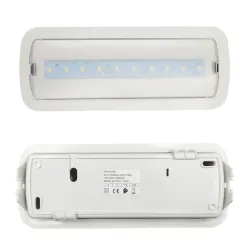
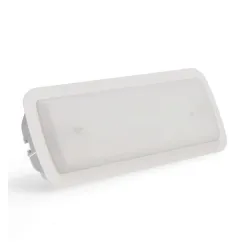
Failing to install LED emergency lights correctly can prove costly. A poor emergency lighting system puts lives at risk. The CTE DB SI emergency regulations state that every building for public, commercial or industrial use must have emergency luminaires that guarantee safe evacuation when the power supply fails.
Here you can buy LED emergency lights that comply with legislation, pass inspection and work correctly when it really matters.
Why emergency lighting is compulsory
Emergency lighting is neither optional nor decorative. Its sole purpose is to enable people to identify evacuation routes and exits when the lights go out. The CTE and the Low Voltage Electrotechnical Regulation (REBT) define precisely where, how much and how each installed LED emergency luminaire must illuminate.
CTE DB SI regulations and minimum requirements
The Basic Document SI establishes that every evacuation zone must have emergency lighting. The UNE EN 60598 approval is the standard certifying that the luminaire passes the required electrical and mechanical safety tests. Premises open to the public, car parks and stairwells in residential buildings with more than one floor always require this system.
Premises with an occupancy of more than 100 people also require it.
Minimum lumens and compulsory installation zones
The minimum emergency lumens required by regulations are 1 lux along the centre line of evacuation routes and 5 lux at points where fire protection equipment is located. The minimum required emergency battery autonomy in hours is 1 hour in non-maintained mode. These values are checked during periodic inspections, and failure to comply means closure of the premises.
Compulsory installation zones include:
- Evacuation routes and corridors.
- Stairwells and entrance lobbies.
- Premises with special risk and areas with a capacity exceeding 100 people.
- Car park areas with a built surface greater than 100m².
- General floor toilets in public-use buildings.
Types of LED emergency luminaires
Choosing the right format depends on the existing installation, the degree of protection needed and the budget.
Self-contained ceiling and surface-mounted emergency light
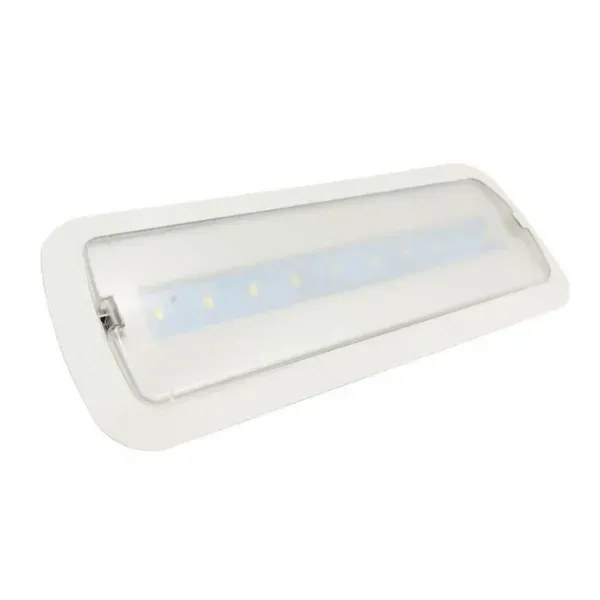
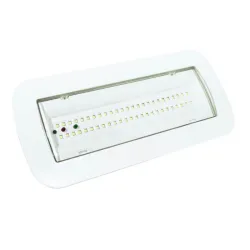
This is the most widespread solution. The LED ceiling emergency light is installed surface-mounted or recessed recessed and surface-mounted emergency installation and has a built-in battery. 4W LED emergency light models offer between 200 and 400 emergency lumens, sufficient for compliance in corridors and common areas.
Battery kit for existing LED luminaires
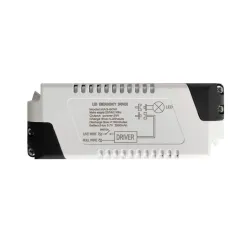
The LED emergency kit adds an LED emergency battery with a charging circuit and automatic changeover. It is an emergency LED for existing luminaires that is far more economical than replacing the entire luminaire. Ideal for refurbishments and extensions.
Approved LED evacuation signs
LED evacuation signage includes standardised exit and evacuation direction pictograms. Unlike photoluminescent signage, the LED evacuation sign is actively illuminated, which improves visibility in dense smoke conditions. Models combine photoluminescent LED evacuation signage with permanent backlighting for maximum safety.
Key features in modern LED emergency lights
Today's LED emergency lights go well beyond switching on when the power goes out. These three features mark the difference between a basic product and a professional solution.
Self-test function for automatic maintenance
The self-test LED emergency light carries out periodic battery and lamp tests automatically self-test maintenance function and signals with an indicator LED if it detects a fault. This saves the installer hours of inspection and ensures the system works correctly when needed.
Maintained mode for continuous lighting
A maintained LED emergency light remains on continuously powered by the mains and switches to battery when the supply is cut. The difference between maintained and non-maintained emergency mode is that maintained mode serves as the area's normal lighting, while non-maintained mode only activates on mains failure.
IP65 for damp areas and outdoors
In car parks, industrial kitchens or covered outdoor areas, an IP65 LED emergency light that withstands projected water and dust is needed. These LED emergency lights with IP65 emergency for damp areas also support IP65 outdoor emergency lighting, which is essential on covered hotel terraces or loading docks.
Applications by sector
Each type of building has specific evacuation and signage requirements. The correct choice of approved LED emergency light depends on the use of the premises and its occupancy level.
Hotels and hospitality establishments
Corridors, stairwells, event halls and service areas must have LED emergency lights and active signage. Models with a presence detector for emergency zones allow lighting to be activated only when someone is in the area, saving battery in autonomous mode.
Shopping centres and large retail premises
High occupancy demands reinforced signage at every corridor junction. It is advisable to combine LED evacuation signs with high-output emergency luminaires in central areas.
Industrial warehouses and storage facilities
High ceiling heights and the presence of dust require LED emergency luminaires with IP65 and high luminous flux. LED emergency kits are particularly useful for converting existing industrial high bays into emergency lighting points without duplicating luminaires.
Educational and healthcare centres
Regulations demand reinforced levels in classrooms with more than 100 pupils, operating theatres and ICUs. The self-test LED emergency function is essential in hospitals where manual verification of hundreds of light points would be unfeasible.
LED signage and emergency lighting catalogue
Browse all the models available in our catalogue. You will find self-contained LED emergency lights, battery kits, evacuation signs and mounting accessories, all approved LED emergency lights in accordance with UNE EN 60598 and CE marked. Filter by wattage, IP rating, operating mode and installation format to find exactly what your project needs.
Frequently asked questions about LED emergency lights
How often should emergency lights be checked according to regulations?
The REBT requires a monthly visual inspection and a full autonomy test every 3 months. Models with self-test LED emergency automate this verification and generate a status log.
What is the difference between a maintained and a non-maintained LED emergency light?
A maintained unit works as normal lighting and switches to battery on mains failure. A non-maintained unit only turns on when the power supply is cut. The choice depends on whether the area needs continuous lighting or only evacuation lighting.
Can I add an emergency battery to my current LED luminaire?
Yes. LED emergency kits connect to the luminaire's driver and provide autonomy of 1 to 3 hours depending on the model. It is the most economical option for bringing existing installations into compliance with the CTE.
What minimum lumens must an emergency light have to comply with the CTE?
A minimum of 1 lux along evacuation routes and 5 lux at fire-fighting equipment points, measured at floor level, with a uniformity ratio no lower than 1:40.
Do emergency lights with self-test still need manual inspection?
They drastically reduce the need for manual inspection but do not eliminate it entirely. Regulations still require periodic visual checks and documentary records of the tests.
.svg)