An LED luminaire is only as good as the driver that powers it. It doesn't matter if you fit the best chip on the market if the LED driver fails, flickers or doesn't regulate properly, the entire installation will be affected.
Choosing the right LED drivers and power supplies is the difference between a project that lasts over 50,000 hours and works correctly, and one that generates a thousand complaints a year. As European leaders in lighting and a leading online distribution shop, here you can buy professional LED drivers and lighting systems with brand warranty and proven compatibility.
What is an LED driver and why is it so important
The driver is the component that converts mains alternating current into the current or voltage the LED needs to operate correctly. Without it, the diode would burn out in a short time. A good driver controls driver wattage efficiency, protects against surges and guarantees flicker-free light. Compatibility with LED strips, panels and high bays depends directly on selecting the right driver for each luminaire.
Constant current vs constant voltage driver
- Constant current: delivers a fixed amperage (e.g. 350 mA, 700 mA, 1050 mA) regardless of the load. It is the standard for panels, downlights and industrial high bays. The relationship between constant current and constant voltage determines which luminaires you can connect.
- Constant voltage: maintains a fixed voltage, typically 12V or 24V, and allows the load to draw what it needs. This is the usual type in power supplies for LED strips.
The choice between one or the other is determined by the luminaire.
How the driver affects the luminaire's lifespan
A low-quality driver introduces current ripple flicker — that imperceptible flickering which causes visual fatigue and headaches. Models with a flicker-free LED driver incorporate filters that reduce ripple to below 5%. And the integrated short-circuit and overload protection prevents a one-off fault in the installation from destroying the LED. The driver lifespan in hours for professional models exceeds 60,000 h, matching or surpassing that of the chip itself.
Types of LED drivers by dimming system
Dimming is what transforms a basic installation into an intelligent system. Depending on the level of control you need, there are three main families of LED drivers.
Non-dimmable driver for fixed installations
The simplest and most economical option. It delivers fixed power with no dimming capability. Perfect for communal areas, warehouses or corridors where the light remains on at 100% throughout the shift. It usually has a power factor PFC above 0.95 and the ENEC TÜV driver certification required by professional specifications.
1-10V dimmable driver for analogue control
The 1-10V dimmable driver receives an analogue signal that varies between 1V and 10V to adjust the luminous flux. It is the most widespread option in offices and retail premises because it is compatible with most potentiometers and sensors on the market. A dimmable LED driver of this type can save up to an additional 30% compared to a fixed installation.
DALI driver for advanced management systems
The DALI protocol takes DALI 1-10V dimming further with bidirectional communication, individual addressing of each luminaire and status monitoring. A DALI LED driver is essential in buildings with BMS systems, hospitals and large retail spaces. Its cost is higher, but the control it offers justifies the investment in sizeable projects. The programmable flux reduction driver allows time-based profiles to be configured to maximise savings.
24V power supplies for LED strips
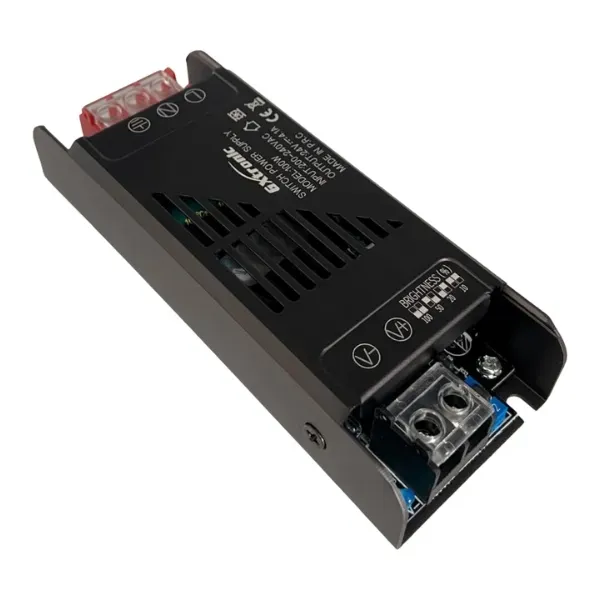
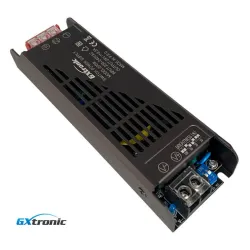
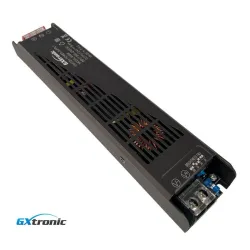
Power supplies are essentially constant voltage drivers designed specifically to feed LED strips and modules. The 24V LED power supply is the dominant format in professional installations due to its balance between safety and energy efficiency.
Power required according to strip length
Add up the consumption per metre of the strip and add a 20% margin. For a 14.4W/m strip over a 10m run, you will need a 400W 24V power supply as a minimum.
For shorter runs of around 5m of decorative strip, a 120W 24V power supply is usually sufficient. A dimmable LED strip driver also allows dimming to be integrated without having to add extra modules.
IP20 models for indoor and IP67 for outdoor use
- IP20 power supply: features a perforated metal casing with natural ventilation. Ideal for false ceilings, furniture and dry areas.
- IP67 outdoor LED driver: has a hermetically sealed resin encapsulation that withstands rain, dust and humidity. Perfect for gardens, facades and exposed signage.
Drivers for specific luminaires
Not all drivers are suitable for everything. The power, current range and physical dimensions vary depending on the target luminaire.
Drivers for 40W and 60W LED panels
The LED panel driver for 40W or 60W typically operates in ranges of 900 mA to 1500 mA. Models with 1-10V or DALI dimming allow the panel to be integrated into office control systems.
Philips Xitanium drivers for high bays and street lights
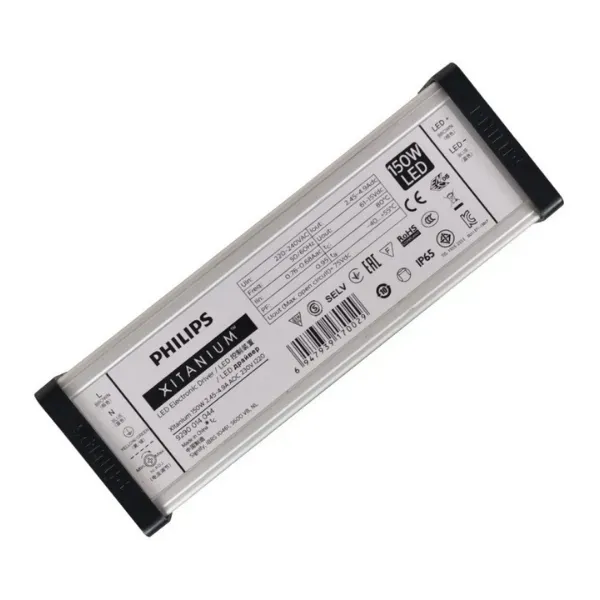
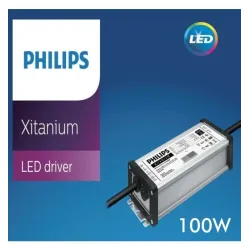
The Philips Xitanium driver is the benchmark for highly demanding projects. Equipped with surge protection of up to 10 kV, a power factor above 0.97 and proven reliability across tens of thousands of industrial and public lighting installations.
An LED driver for industrial high bays with Xitanium offers programmable dimming and an extended warranty of up to 5 years. The lumens per watt achieved by the chip-Xitanium combination exceed 160 lm/W.
Lifud drivers for panels with dimming
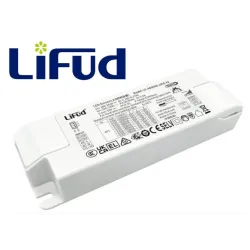
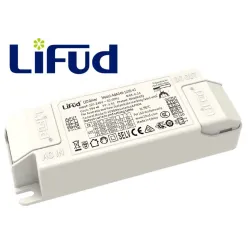
The Lifud LED driver is a professional alternative with an excellent quality-price ratio. It offers DALI, 1-10V and non-dimmable models with ENEC and TÜV certification. Its panel range covers from 25W to 65W. The low ripple level guarantees flicker-free operation even when dimmed to 10% of the flux.
Power supplies and LED drivers catalogue
Explore the latest LED solutions for LED drivers and power supplies organised by dimming type, power and compatibility. All products include a technical data sheet with efficiency curves, wiring diagrams and ENEC TÜV driver certification data.
Contact our team of experts at your service for personalised customer support.
Frequently asked questions about LED drivers and power supplies
What is the difference between a constant current and a constant voltage driver?
A constant current driver delivers a fixed amperage and allows the voltage to adjust; it is used for panels, downlights and high bays. A constant voltage driver maintains a fixed voltage of 12V or 24V and is used for LED strips and modules. Connecting a luminaire to the wrong type can irreversibly damage the LEDs.
Can I replace the driver of an industrial high bay without changing the entire luminaire?
Yes, provided the new driver matches in output current, power range and physical dimensions. This is a common practice to improve dimming or extend the overall lifespan of the unit.
What power supply wattage do I need for 10 metres of 24V LED strip?
It depends on the strip's consumption per metre. Multiply watts/metre by the total metres and add a 20% margin. For a 14.4W/m strip over 10m, you need at least 173W actual, so a 200W power supply is the recommended minimum.
Are DALI drivers compatible with KNX systems?
Yes, via DALI-KNX gateways that translate the protocols. Integration is standard in smart buildings and allows each luminaire to be controlled from the centralised management system.
What is current ripple and how does it affect light flickering?
Ripple is the residual fluctuation in the driver's output current. High ripple causes flickering that leads to visual fatigue. Professional drivers keep ripple below 5%, guaranteeing stable and comfortable light.
.svg)