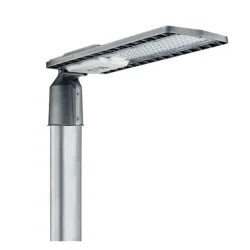
Public LED lighting reduces the electricity bill by between 50% and 70% compared to old sodium vapour lamps, with superior light quality and low maintenance. Here you will find everything you need to buy urban LED street lights with all the features, certifications and warranties required for efficient public lighting.
Why upgrade public lighting to LED
The switch to public LED lighting is not just a matter of savings — it also affects road safety, light pollution and compliance with current outdoor lighting regulations. The technical and economic arguments are so solid that most municipal energy efficiency plans already prioritise it.
Energy savings compared to sodium vapour and metal halides
A 150W sodium vapour street light can be replaced by a 100W LED street light that delivers the same or better illuminance levels. The sodium vapour to LED replacement saves on consumption but also on power and reactive power penalties. With ratios exceeding 140 lumens per watt for road use, LED delivers more light with less energy.
Reduced maintenance for municipalities
Discharge luminaires require lamp replacement every 12,000–16,000 hours. A municipal LED street light achieves an LED street light lifespan of 50,000 hours or more — over 12 years of operation without changing the light source.
The maintenance savings, combined with the energy savings, place the typical payback period at between 3 and 5 years.
Types of LED street lights for public use
Not all roads are lit the same way. The choice of luminaire type depends on the carriageway width, mounting height, traffic flow and the aesthetics of the surroundings.
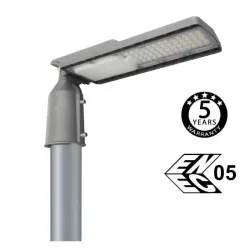
Urban LED street light for streets and avenues
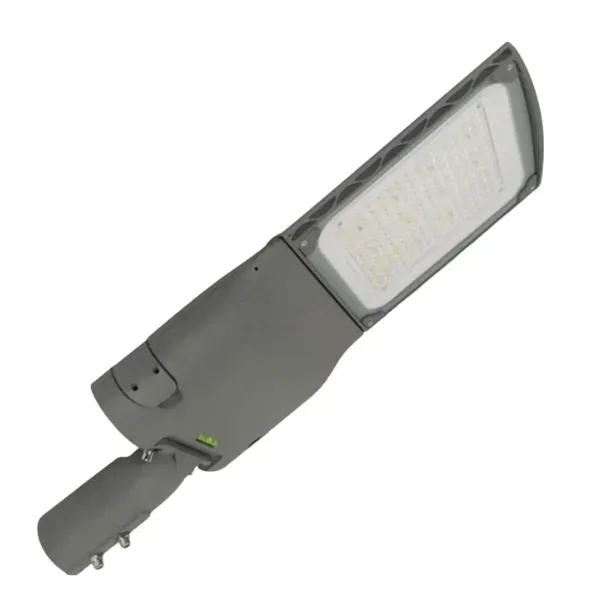
The urban LED street light is installed on columns of 4 to 8 metres and covers residential streets, promenades and commercial avenues. A 4000K colour temperature for road use is typically used, offering good colour rendering without being excessively cool. Models with asymmetric optics direct the light towards the carriageway and pavements, limiting emission to the upper hemisphere.
Road LED street light for highways and industrial estates
For interurban roads, roundabouts and industrial estates, a higher-power road LED street light with greater optical reach is required. Mounting heights range between 8 and 12 metres, and typical power ratings go from 80W to 240W.
The LED road lighting criterion prioritises longitudinal uniformity and glare control, with Type II and Type III photometric distributions according to the IESNA classification.
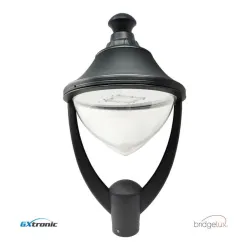
Globe and villa street lights for parks and residential areas
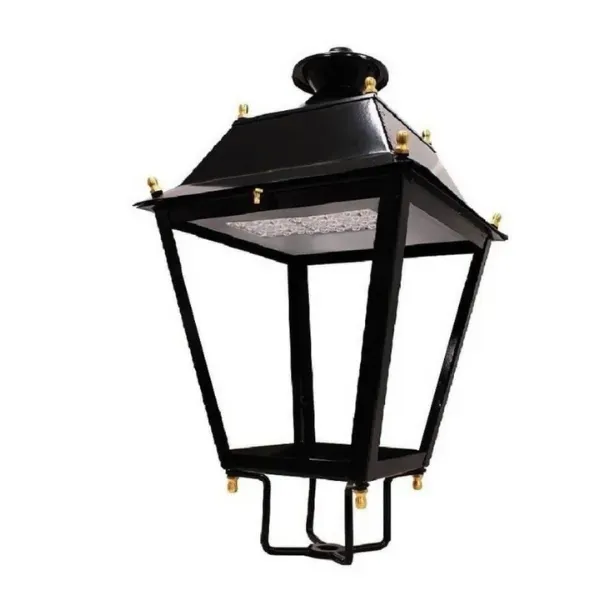
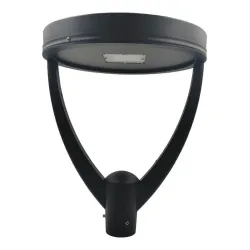
Parks, squares and housing developments demand luminaires with a more refined aesthetic component. Globe or villa-type street lights incorporate diffusers that soften the light and provide a classic or contemporary appearance depending on the model. They are an efficient urban LED lighting solution that combines performance with design.
Solar LED street light for areas without mains power
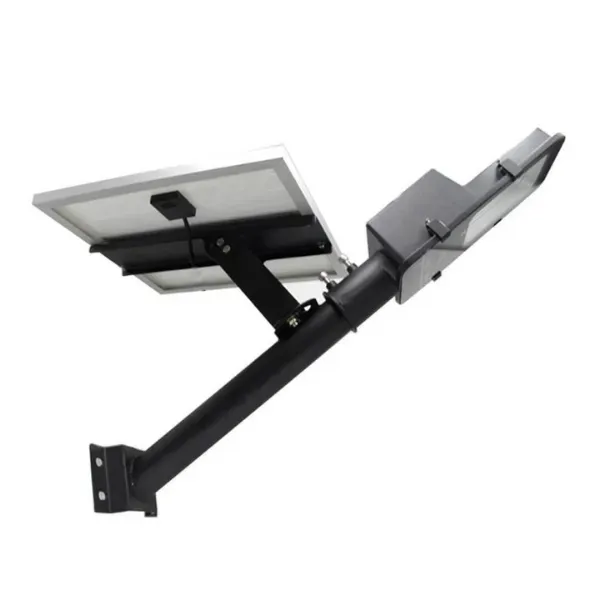
When there is no electrical supply — such as rural paths, footpaths or newly developed areas — the solar LED street light provides autonomous lighting. This lighting system incorporates a photovoltaic panel, a lithium battery and an intelligent controller that manages charging and nighttime flux reduction.
Key components in professional LED street lights
The long-term performance of a street light depends directly on the quality of its internal components.
Philips Lumileds and Bridgelux chips for outdoor use
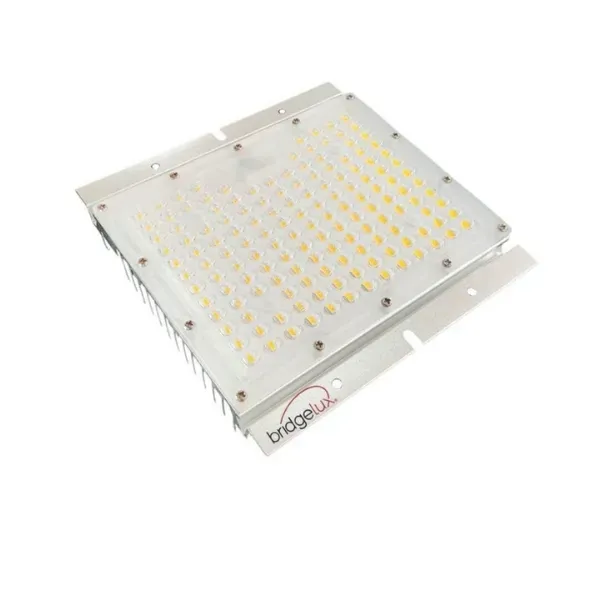
Philips Lumileds and Bridgelux LEDs are the best choice for efficient LED lighting projects. The Philips Lumileds outdoor chip is an LED technology that guarantees chromatic stability, low flux depreciation and efficiencies above 140 lm/W. The Philips Lumileds LED street light series in our catalogue features these emitters as standard.
Programmable driver with nighttime flux reduction
A good programmable driver with nighttime reduction allows the configuration of up to 5 time slots with different power levels. For example:
- 100% flux from 19:00 to 23:00.
- 70% from 23:00 to 01:00.
- 50% from 01:00 to 06:00.
This programming, specific to each programmable LED street light and LED street light with programmable driver, further reduces total annual energy consumption. Models compatible with remote management allow these profiles to be modified in public spaces remotely.
Surge protection up to 10kV
Public lighting lines suffer voltage spikes caused by electrical storms and grid switching operations. Integrated 10kV surge protection in the luminaire prevents failures and is a differentiating factor that many low-end manufacturers omit. All professional street lights in our catalogue include a varistor and differential protection up to 10 kV.
Regulations and certifications for outdoor lighting
Tendering for public luminaires without knowing the regulatory framework is a risk that no technician should take. Requirements range from mandatory markings to photometric levels by road type.
CE and RoHS requirements in public lighting
Every luminaire marketed in the European Union must bear the CE marking and comply with the RoHS directive. However, for public projects it is also advisable to require independent photometric reports in IES or LDT format, and test certificates according to EN 60598 and EN 62471.
Illuminance levels according to road type
The EN 13201 standard classifies roads into categories (ME, CE, S, A) and establishes minimum values for luminance, uniformity and glare. A residential street classified as S3 requires 7.5 lux, whilst an ME2 road requires 1.5 cd/m² of luminance.
Knowing these values is essential for correctly sizing road LED street lights and urban luminaires for each project.
Accessories and installation elements
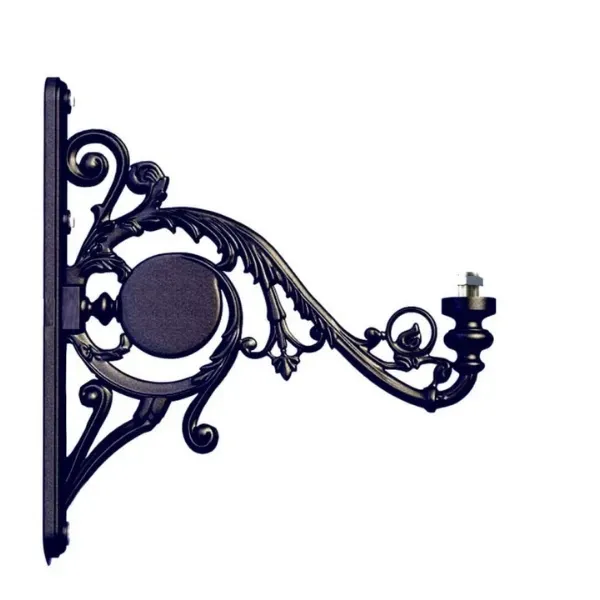
The luminaire is only one part of the light point. The urban street light column post, wall bracket and fixing accessories complete the installation.
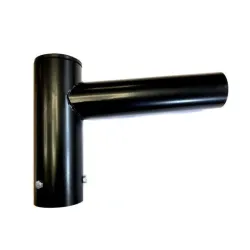
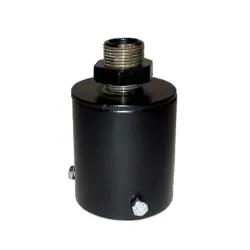
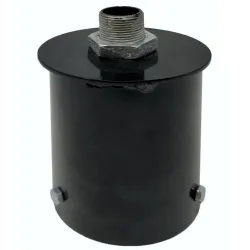
Columns, brackets and supports for LED street lights
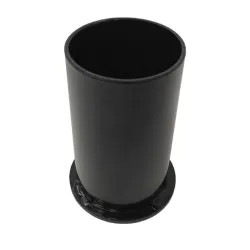
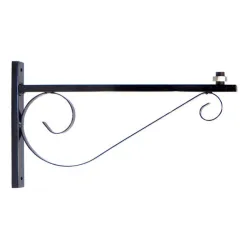
We stock galvanised steel columns with heights from 3.5 to 12 metres, single and double brackets, and diameter adapters for retrofit onto existing columns. The IP66 LED street light is fixed to the bracket using an adjustable clamp that allows the optics to be oriented at various angles. The IP66 weather resistance protects all electronics against direct rain, dust and coastal saline environments.
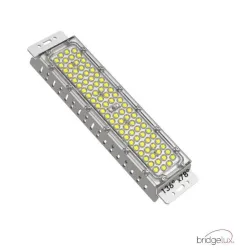
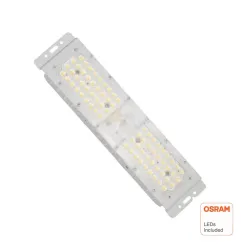
Optical modules and lamps for direct replacement
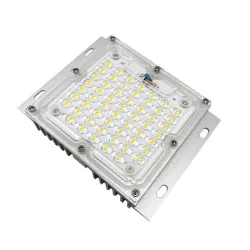
For quick renovations without changing the column or bracket, we offer direct replacement optical modules with E27 and E40 caps. Perfect for a municipal renovation plan, where immediate savings are prioritised and the complete luminaire replacement is left for a second phase.
Public and road LED lighting catalogue
Explore the wide range of street lights, optical modules, columns and accessories available. Each product includes a downloadable technical data sheet with photometric curve, electrical data and certifications so you can incorporate it directly into your project or tender specifications. Find the solution that best suits your public LED lighting installation.
Frequently asked questions about LED street lights
How many watts does an LED street light need to illuminate an urban street?
It depends on the carriageway width and mounting height. A single-lane residential street is usually resolved with 40–60W and a dual-carriageway avenue with 80–150W. The calculation should always be done with photometric software to comply with EN 13201.
What is the programmable driver in an LED street light and what is it for?
It is the internal power supply that, in addition to converting the current, allows different power levels to be programmed according to time slots. It reduces energy consumption during low-activity hours without the need for external dimmers.
Are LED street lights compatible with remote management systems?
Yes, provided they incorporate a driver with DALI protocol or 0–10V output. Many models accept point-to-point or networked remote management modules, enabling remote control from a centralised platform.
What regulations govern outdoor public lighting in Spain?
The main reference is Royal Decree 1890/2008, supplemented by the EN 13201 standard for lighting levels and the complementary technical instructions (ITC-EA).
What is the payback period for upgrading public lighting to LED?
With energy savings of 50% to 70% and the drastic reduction in maintenance, most projects pay for themselves within 3 to 5 years. In municipalities with high electricity tariffs or very outdated lighting, the payback can be even less than 3 years.
.svg)