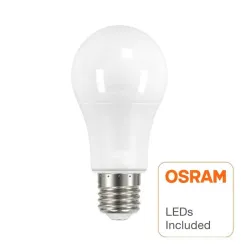
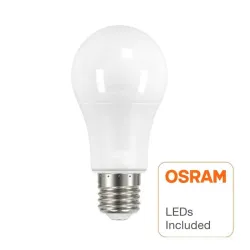
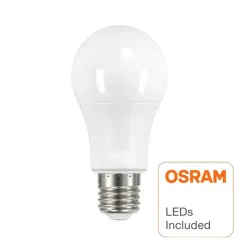
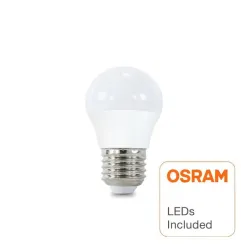
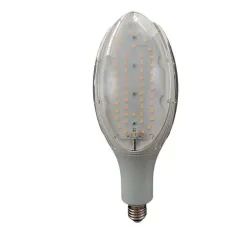
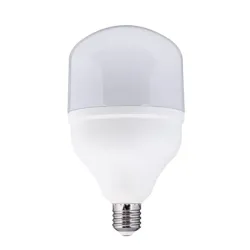
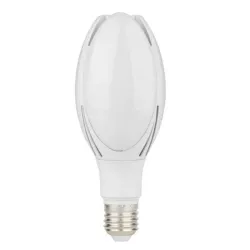
Here you'll find the complete catalogue of E27 LED bulbs for the standard universal E27 cap: the most widely used fitting in table lamps, wall lights, ceiling lights, and pendant fittings. All models feature an Osram Duris chip, carry CE RoHS certification, and have a rated service life of up to 25,000 hours. Filter by shape, wattage, or colour temperature to find the model you need.
Which E27 LED bulb do you need for your fitting?
The E27 cap is the most common fitting in domestic and commercial use. Before choosing a model, check the available space inside the luminaire. The G80 and G95 globe formats have a larger diameter and may not fit inside enclosed shades.
Available formats: A60, G45, G80, G95, and filament
The range covers five main formats. The A60, G45, G80 globe, and candle formats include the most common models used in domestic and commercial installations:
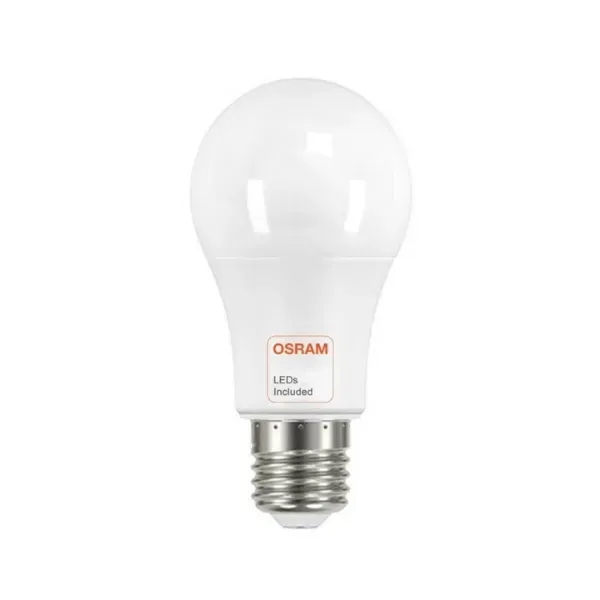
- A60: standard shape, general use in any light point.
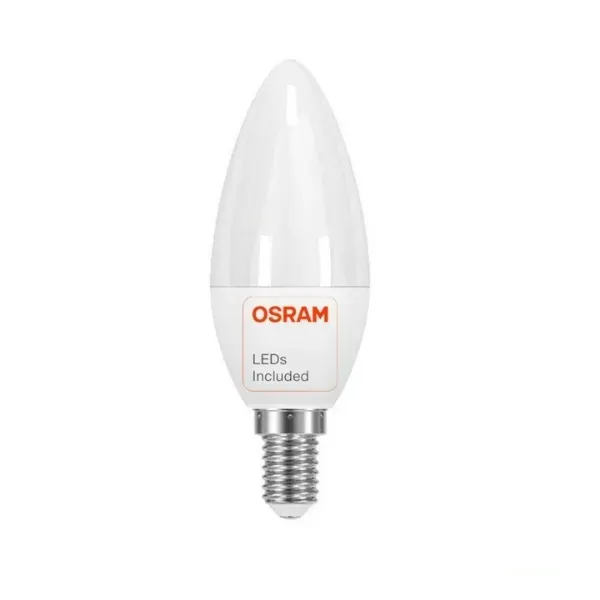
- G45: small candle-style format, suited to wall lights and compact decorative lamps. The 6W G45 E27 LED bulb is the standard reference in this format.
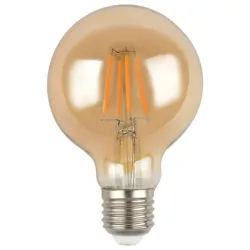
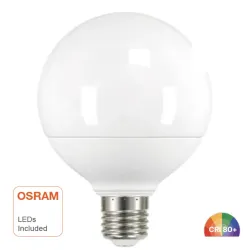
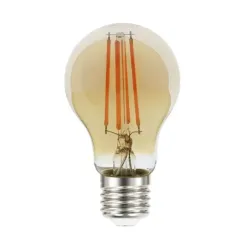
- G80 / G95: larger-diameter globes, highly visible as a decorative element. The G80 and G95 globe E27 LED bulb is available in a vintage filament version with a retro effect.
The emission angle, 180° or 300°, distinguishes two different behaviours: omnidirectional models (A60, globe) emit at 300° and light the surrounding area fully. Candle and G45 models emit at 180° and focus light downwards.
How to choose the wattage for your application
Wattage determines the luminous output. For most residential light points, the useful range is 6 W to 15 W.
The 9W Osram E27 LED bulb is the most popular choice for general domestic use. For large rooms or task lighting, the 15W high-brightness E27 LED bulb delivers an output equivalent to a 100 W incandescent.
Colour temperature by room
Colour temperature, 2700K, 4000K, or 6500K, determines the tone of the light. Choosing correctly affects visual comfort and how each space is used.
2700K for living rooms and bedrooms
Light at 2700K is warm, with a tone similar to traditional incandescent bulbs. It reduces eye strain in rest areas. The 2700K warm white E27 LED bulb is the standard choice for living rooms, bedrooms, and dining rooms. The CRI colour rendering index on these models is ≥80, which is sufficient for a natural perception of colour in domestic settings.
4000K for kitchens and workspaces
Neutral light at 4000K improves visibility on work surfaces without the harshness of daylight white. Recommended for kitchens, home offices, and garages. For installations where variable requirements apply, the CCT-selectable E27 LED bulb lets you switch between 2700K, 4000K, and 6500K from the same light point.
Dimmable E27 LED bulbs
Dimmable E27 LED bulbs feature a TRIAC-compatible dimming driver, making them compatible with the most widely used dimmer switches in domestic installations. Before fitting, check that your dimmer is on the manufacturer's compatibility list.
The dimmable A60 E27 LED bulb is available in 2700K and 4000K. For outdoor installations with a dimmer, refer to the IP-rated models: the IP44 E27 LED bulb for outdoor use can withstand moisture and splashing.
If your installation does not use a dimmer, the flicker-free E27 LED bulb with a stabilised driver is the right choice to avoid flicker.
Equivalents to incandescent and halogen bulbs
The table below makes it easy to convert between wattages. The incandescent equivalent wattage shown is indicative and may vary depending on the lumen output of each specific model.
| LED wattage |
Incandescent equivalent |
Halogen equivalent |
Approx. output |
| 6 W |
40 W |
35 W |
~600 lm |
| 9 W |
60 W |
52 W |
~900 lm |
| 12 W |
75 W |
65 W |
~1,100 lm |
| 15 W |
100 W |
85 W |
~1,500 lm |
| 40 W |
— |
— |
~4,000 lm |
The most common equivalent to a 60W incandescent in this catalogue is the 9 W model.
For high-demand applications, the 40W high-resistance E27 LED bulb is designed for frequent switching cycles and high-temperature environments.
If you need to replace several units, buying E27 LED bulbs in a multipack reduces the cost per unit.
Why choose the Osram Duris chip
The premium-quality Osram Duris chip is what sets these models apart from bulbs of unknown origin. Osram manufactures the chip to tighter tolerances for luminous output and colour temperature than generic chipsets, which means less variation between units from the same batch.
The affordable Osram chip E27 LED bulb in this catalogue maintains those tolerances without significantly increasing the product cost. If you compare E27 LED bulb prices with other brands that use uncertified chips, the cost difference is small, especially against the difference in service life and output stability. The CE RoHS certification confirms compliance with European electrical safety and hazardous substances regulations.
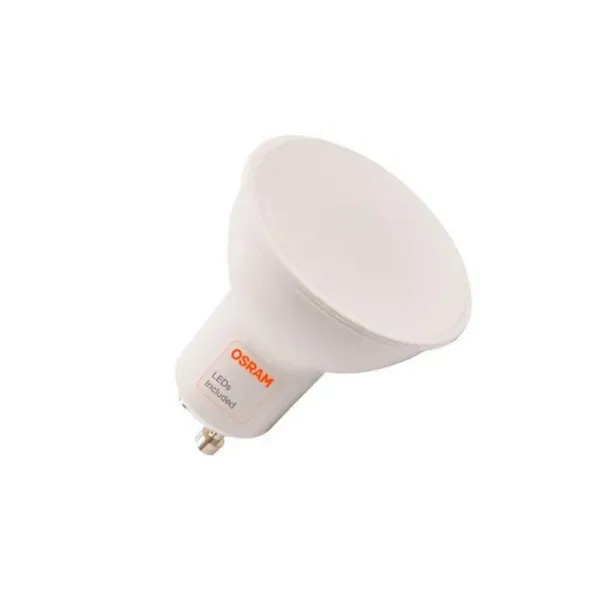
If you need other cap types, see also the catalogue of E14 bulbs for chandeliers and small wall lights, or the GU10 bulb catalogue for recessed spotlights.
Frequently asked questions about E27 LED bulbs
Which E27 LED bulb is equivalent to a 60W incandescent?
A 9 W bulb with an Osram chip produces around 900 lm, the practical equivalent of a 60 W incandescent. The best-selling 60W-equivalent E27 LED bulb in this catalogue has exactly that wattage.
Can I use an E27 LED bulb in any lamp?
Yes, provided the lamp has a standard universal E27 cap. Check that the globe diameter fits inside the shade: the G80 and G95 formats are wider than the standard A60.
Can E27 LED bulbs be dimmed?
Only models marked as dimmable, which feature a TRIAC-compatible driver. Non-dimmable bulbs may flicker or be damaged if connected to an active dimmer.
How much will I save by switching to E27 LED bulbs?
A 9 W LED bulb uses 85% less energy than a 60 W incandescent. With four hours of daily use, the saving per bulb exceeds £10 a year on your electricity bill, plus the cost of replacements. The rated 25,000-hour service life is between 15 and 25 times longer than that of an incandescent.
Which colour temperature should I choose for the living room?
For living rooms and rest areas, 2700K is the standard choice. It produces warm light that does not interfere with relaxation and maintains a suitable CRI for colour rendering in the home.
.svg)